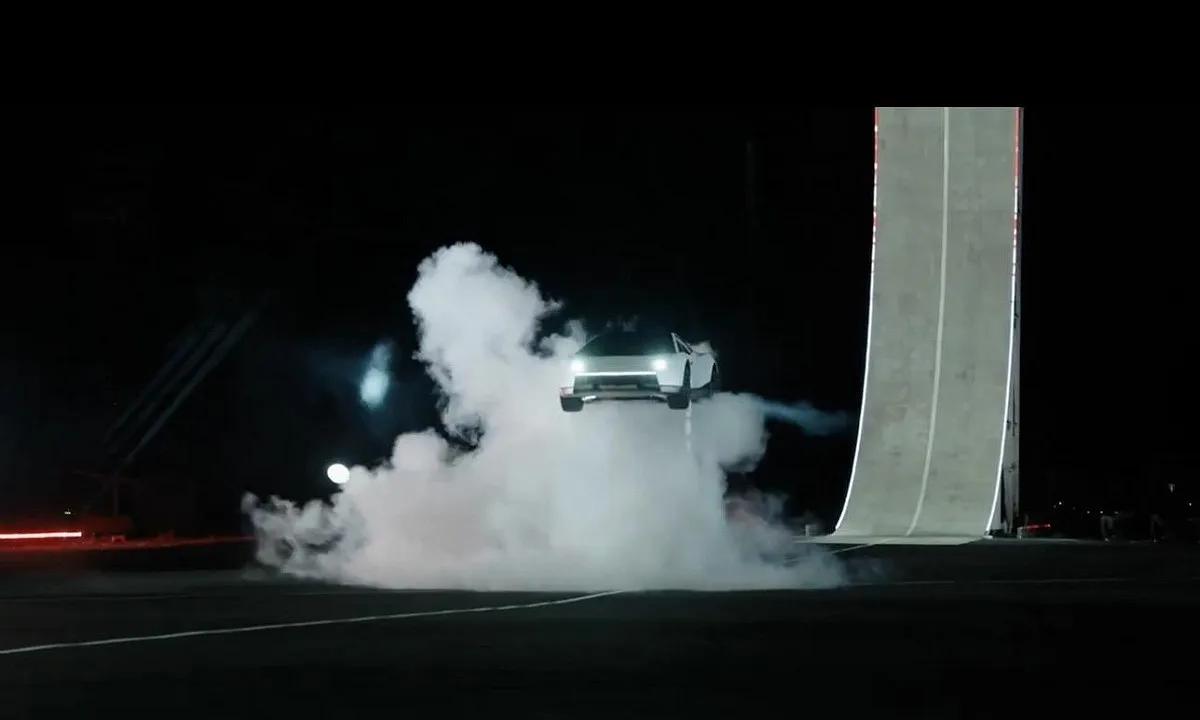
Tesla’s next-generation Roadster has finally made its long-awaited public debut, and its most unbelievable feature is exactly what the name suggests: it can appear to leave the ground.
Unveiled on October 15, 2026, the new electric supercar was demonstrated using a combination of SpaceX-related cold-gas thrusters and a suction-based system. The presentation showed the vehicle performing dramatic maneuvers, including driving upside down on a specially designed ramp, briefly lifting into the air, and flipping before landing.
Tesla CEO Elon Musk has also claimed that the Roadster can accelerate from 0 to 60 mph in less than one second when equipped with its advanced propulsion technology.
But there is an important catch: Tesla has not yet provided a complete set of independently verified production specifications, and the spectacular demonstration does not mean every Roadster can fly freely or legally on public roads.
The company says production is planned for 2028, extending a project that was first announced in 2017 and delayed repeatedly.
Here is what we know about the new Tesla Roadster, its SpaceX-inspired technology, performance claims, reservation costs, potential road restrictions, and expected production timeline.
What Is the New Tesla Roadster?
The Tesla Roadster is a high-performance, all-electric sports car designed to showcase the limits of electric vehicle engineering.
The second-generation Roadster was originally unveiled as a prototype in November 2017. Tesla initially targeted production for 2020, but the vehicle remained in development as the company concentrated on other vehicles and manufacturing priorities.
The October 2026 reveal introduced a redesigned version with a much more ambitious technological concept: combining an electric supercar with propulsion technology associated with SpaceX, Musk’s aerospace company.
The result is a vehicle intended to go beyond traditional electric sports car performance.
Instead of relying entirely on tires to transfer power to the road, the experimental propulsion system is designed to generate additional force through onboard thrusters. A separate suction-based system was also demonstrated during the event.
Tesla has not yet supplied all the technical information needed to independently evaluate the complete production vehicle. Details such as final battery capacity, motor output, charging performance, and the full specifications of each version should therefore be treated as unconfirmed until the company publishes them.
Can the Tesla Roadster Really Fly?
This is the question most people want answered.
During the October 15 demonstration, the Roadster performed a series of unusual maneuvers using a specially prepared setup. The vehicle drove along a curved ramp, appeared upside down, and then used propulsion technology to perform aerial movements.
The demonstration was striking, but understanding what happened requires separating three different technologies.
1. Cold-gas thrusters
Cold-gas thrusters generate force by releasing pressurized gas through nozzles. Unlike conventional rocket engines that burn propellant, a cold-gas system produces thrust without combustion in the thruster itself.
The basic principle is straightforward: gas expelled in one direction creates a force in the opposite direction.
In a vehicle, carefully arranged thrusters could potentially provide additional force beyond what tires and electric motors can deliver. Their effectiveness depends on the system’s pressure, gas supply, nozzle design, thrust direction, and control system.
However, cold-gas propulsion has practical limitations, including the amount of gas that can be stored, how quickly it is consumed, and how much thrust the system can sustain.
Tesla and SpaceX have not yet published enough independently verified engineering data to establish every operational limit of the production Roadster.
2. A suction-based system
The demonstration also involved a system intended to create suction beneath the vehicle.
Suction can help a vehicle remain attached to a specially designed surface, potentially allowing it to travel in orientations that ordinary cars cannot manage.
This is fundamentally different from flying.
A car driving upside down on a purpose-built ramp is not necessarily capable of hovering freely in open air. The surface, suction system, vehicle geometry, and control mechanisms all play important roles.
3. Actual flight versus a short aerial maneuver
For a car to hover or fly independently, it must generate enough upward thrust to overcome its weight and continuously control its orientation.
It must also manage stability, wind disturbances, propulsion-system failures, landing forces, and passenger safety.
A brief lift or aerial stunt does not establish that a vehicle can take off vertically, travel long distances through the air, or operate like a helicopter.
The most accurate conclusion is that Tesla has demonstrated an experimental vehicle using thrusters and a suction-based system. The full capabilities, operating limits, and legal status of the production versions still require clarification.
Tesla Roadster Performance: Is 0–60 MPH in Under One Second Possible?
Musk has claimed that the new Roadster can accelerate from 0 to 60 mph in less than one second with its advanced propulsion system.
That is an extraordinary target.
For comparison, 60 mph is approximately 96.6 km/h. Reaching that speed in under one second would require an average acceleration exceeding 27 meters per second squared, or roughly 2.7 times Earth’s gravitational acceleration.
That calculation describes the average acceleration needed to reach the claimed speed. Actual forces would vary throughout the acceleration process.
Conventional road cars face a major limitation: tire grip.
Even a powerful electric motor cannot continuously accelerate a car beyond the traction available between its tires and the road. Adding another source of thrust could theoretically change that limitation, but it introduces new engineering challenges involving stability, braking, control, and safety.
Tesla’s claim should not be confused with an independently verified production-car test. Until standardized testing confirms the result, the sub-one-second figure remains a manufacturer performance claim.
The same caution applies to top speed, range, battery capacity, and other figures that have not been confirmed for the final production vehicle.
For buyers, the most useful future tests will include repeatable acceleration runs, braking distances, high-speed stability, thermal performance, and range under realistic driving conditions.
Tesla Roadster Versions: Performance, Thrust and Rocket
Reports following the reveal describe three Roadster configurations: Performance, Thrust, and Rocket.
Their names suggest different levels of capability, but the most important distinction is that the versions are not necessarily interchangeable.
Performance
The Performance version is positioned as the more conventional road-focused configuration.
Reports indicate that reservations require a $50,000 deposit. That is a reservation amount, not the confirmed final purchase price of the vehicle.
The final equipment list, production specifications, delivery schedule, and applicable market restrictions still need to be confirmed.
Thrust
The Thrust version is associated with additional propulsion equipment and more extreme acceleration claims.
Reports indicate a $250,000 deposit for this configuration. Again, that figure represents the reported reservation requirement, not a confirmed total vehicle price.
Potential buyers should wait for complete documentation covering the included equipment, operating restrictions, maintenance requirements, and delivery conditions.
Rocket
The Rocket version is described as an invitation-only configuration with a single-seat layout and a more ambitious flight-oriented system.
This is the version most closely associated with the idea of a flying car.
However, a system designed for experimental flight-like maneuvers should not be assumed to be approved for ordinary public-road use. Buyers must distinguish between an experimental capability and a certified, legally usable feature.
Tesla’s final documentation will need to clarify the Rocket version’s intended operating environment and regulatory status.
How Much Does the Tesla Roadster Cost?
As of October 16, 2026, international reports have not established a confirmed final purchase price for the new Roadster.
The reported reservation deposits are:
| Version | Reported reservation deposit | Key distinction |
|---|---|---|
| Performance | $50,000 | Road-focused configuration |
| Thrust | $250,000 | Additional propulsion technology |
| Rocket | Invitation only | Single-seat, flight-oriented concept |
These figures should not be interpreted as the vehicle’s final retail prices. A reservation deposit is not the same as the total amount a buyer must pay to take delivery.
Before making a reservation, prospective buyers should review the official terms, including whether deposits are refundable, when additional payments become due, how cancellations are handled, and whether delivery dates are guaranteed.
The final cost could also vary by market because of taxes, import duties, registration requirements, and other local charges.
Tesla has not yet supplied enough public information to calculate a reliable final ownership cost across markets.
When Will the Tesla Roadster Go Into Production?
Tesla says production is planned for 2028.
That is an important milestone, but it is not the same as a guaranteed delivery date.
The project has a long history. When Tesla unveiled the second-generation Roadster in 2017, production was initially expected in 2020. The schedule subsequently moved several times as development continued.
The October 2026 reveal therefore represents a significant step in the project’s public progress, but it does not prove that mass production is ready to begin.
Before deliveries can start at scale, Tesla will need to finalize the vehicle’s design, validate its systems, prepare manufacturing, secure the necessary regulatory approvals, and establish a reliable supply chain.
The more experimental the propulsion technology, the more important it becomes to understand how it will be tested, maintained, and certified.
For reservation holders, the key questions are not simply whether production begins in 2028, but when their specific configuration will be built and whether the final vehicle will match the advertised specifications.
Is the Tesla Roadster Street Legal?
Not every feature shown during a technology demonstration should be assumed to be legal for use on public roads.
A production sports car must comply with the safety and vehicle regulations applicable in each market. Additional propulsion systems may raise questions involving noise, high-pressure gas storage, pedestrian safety, crash protection, and safe operation near other vehicles.
A Rocket configuration designed for experimental flight-like maneuvers may face different restrictions from a road-focused Performance model.
The legal status of each version must therefore be evaluated separately.
Consumers should look for official documentation identifying which configurations are certified for public roads, which functions are permitted during normal driving, and whether any special equipment requires additional approvals.
Until those details are clear, it would be misleading to assume that every Roadster can perform the same stunts demonstrated at the reveal event.
Why the Roadster Matters for Tesla
The Roadster is more than another electric vehicle. It is a technology showcase intended to demonstrate what Tesla and SpaceX engineers might achieve by combining automotive and aerospace expertise.
Unlike a mass-market sedan or SUV, a high-performance halo car does not need to sell in enormous numbers to attract attention to a company’s engineering ambitions.
The Roadster gives Tesla an opportunity to demonstrate advanced acceleration, aerodynamic design, experimental propulsion, and a distinctive approach to vehicle performance.
However, a dramatic prototype and a successful production program are two different achievements.
The real test will be whether Tesla can turn its promises into a vehicle that customers can buy, maintain, insure, and use within the limits of applicable laws.
Reliability, repeatable performance, service support, and transparent specifications will ultimately matter as much as the spectacle of a flying demonstration.
Tesla Roadster vs. Traditional Electric Supercars
The Roadster’s proposed propulsion system sets it apart from conventional electric performance cars.
Most electric supercars depend on electric motors, sophisticated traction control, aerodynamic downforce, and high-performance tires.
The Roadster’s experimental approach adds a different dimension by using thrusters to generate force independently of tire traction.
That could theoretically offer advantages during certain acceleration or demonstration maneuvers. It also introduces complications that conventional cars generally do not face.
A propulsion system that stores pressurized gas requires additional hardware, inspections, safety controls, and maintenance. It may also impose limits on how often the vehicle can perform its most extreme maneuvers.
For everyday driving, buyers will still need to consider braking, cornering, ride comfort, charging, range, and reliability.
Until independent testing becomes available, it is too early to conclude that the Roadster will outperform every competing supercar in real-world conditions.
Frequently Asked Questions
Can the Tesla Roadster actually fly?
Tesla demonstrated a Roadster performing brief aerial maneuvers using propulsion technology and a suction-based system. This does not establish that every version can freely fly, hover for extended periods, or operate as an aircraft.
How fast is the new Tesla Roadster?
Elon Musk has claimed that the vehicle can accelerate from 0 to 60 mph in under one second with its advanced propulsion system. Independent testing of the final production version is still needed to verify the claim.
How much does the Tesla Roadster cost?
As of October 16, 2026, a confirmed final retail price has not been established in international reports. Reported reservation deposits are $50,000 for Performance and $250,000 for Thrust. The Rocket version is described as invitation-only.
When will the Tesla Roadster be available?
Tesla has said production is planned for 2028. A confirmed delivery date for individual buyers has not been established.
Is the Rocket version street legal?
Its intended use and regulatory status require careful verification. Buyers should not assume that a flight-oriented configuration is approved for ordinary public-road driving.
Is the Roadster a practical everyday car?
That depends on the final production specifications and the owner’s needs. Its high-performance focus, specialized propulsion technology, and uncertain delivery timeline make it different from an ordinary electric commuter car.
The Bottom Line: A Flying-Car Demonstration, but Many Questions Remain
The new Tesla Roadster is one of the most ambitious electric sports car projects yet demonstrated publicly.
Its combination of electric performance, SpaceX-related thrusters, and suction-assisted maneuvers creates a striking vision of what a car might become.
But the most important details are still unfolding.
The final retail price, complete production specifications, independently verified performance, regulatory status, and delivery schedule will determine whether the Roadster becomes a practical product or remains primarily a showcase for experimental engineering.
Tesla is targeting production in 2028. Until the company publishes more complete documentation and customers can evaluate the finished vehicle, the best approach is to separate what was demonstrated from what has been promised.
The Roadster may push the boundaries of the traditional supercar, but its ultimate success will depend on much more than whether it can briefly leave the ground.