🎲 What if you could be born again—but had absolutely no control over where you were born or who your parents were?
Would you grow up in a wealthy family? An ordinary household? Or somewhere you never expected?
Meet 1 in 8 Billion, a free browser-based life simulator that lets you explore a completely different life from birth to death.
You don’t get to choose your starting point. Instead, the game uses real-world population and social statistics to simulate a life shaped by your birthplace, family circumstances, education, health, relationships, and personal decisions.
And here’s the fascinating part: two people can start life in very different circumstances, even though neither chose where they began.
You can experience it yourself, make decisions along the way, and see how your simulated life unfolds.
👉 Play the game: https://1in8b.life/zh/
No standalone app download is required, and you can start playing in your browser without creating an account for ordinary gameplay.
This guide covers how to play, how the birth lottery works, what the life stats mean, how to compare different scenarios, and how to test the game’s mechanics without jumping to conclusions.
1. What Is 1 in 8 Billion?
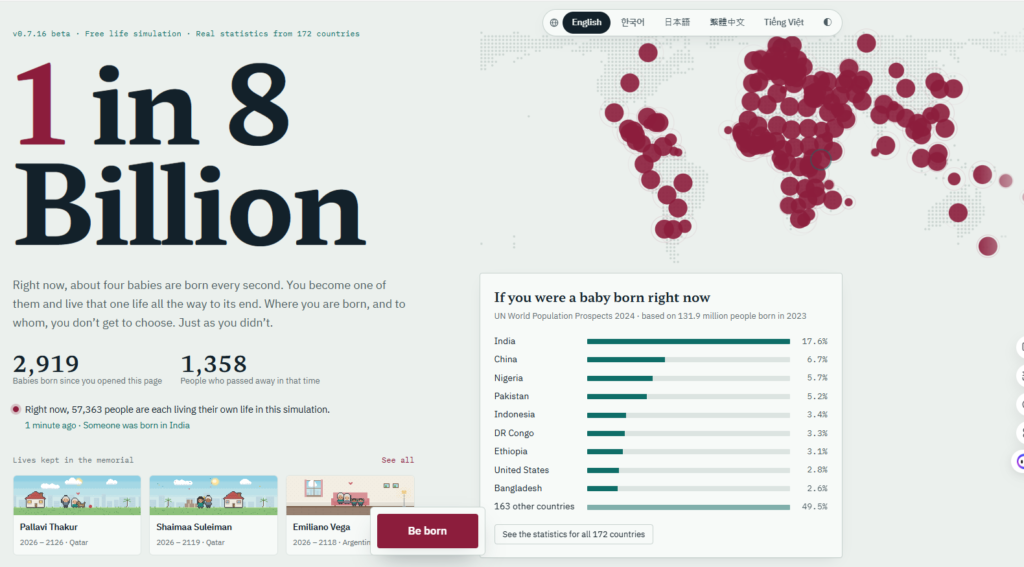
1 in 8 Billion is a life simulation game built around a simple but powerful idea: what might your life look like if you were born somewhere else?
The game covers 172 countries and regions, using real-world demographic and social statistics to create simulated life experiences.
You begin at age zero and move through different stages of life. Along the way, you may encounter education, work, relationships, family, health challenges, and other life events.
Unlike traditional role-playing games, there’s no single storyline that every player must follow.
Every new life can have a different starting point and a different outcome.
What makes this game interesting?
- 🎲 Random birth: You don’t simply pick your favorite country or family background.
- 🌍 172 countries and regions: Explore different starting conditions around the world.
- ⏳ Different eras: Try simulations set in the past, present, or future.
- 🧠 Four life stats: Track health, happiness, knowledge, and relationships.
- 🎯 Life decisions: Make choices yourself or let the game handle them automatically.
- 📖 Life records: Review important events after your simulated life ends.
- 👥 Other lives: Compare your experience with four other lives born in the same second.
The game is currently described as a test version, so its interface and features may change over time.
2. How to Play 1 in 8 Billion
Getting started is straightforward. You don’t need gaming experience or a complicated setup.
Step 1: Open the game
Visit the official game page:
The linked page is the Traditional Chinese version. If you don’t read Chinese, you may need to use your browser’s translation feature.
Open it in a modern browser such as Chrome, Edge, or Safari. No separate game app is required.
Step 2: Choose your world
The game offers four world settings.
| Setting | What it means |
|---|---|
| Past | Explore a simulated life using historical-era data |
| Present | Start with contemporary data |
| Future | Explore a scenario based on future projections |
| Any world | Let the game choose for you |
First-time tip: Start with the present-day world. It’s easier to understand the game’s life stats and events before experimenting with historical or future settings.
Keep in mind that future scenarios are simulations based on projections, not guaranteed predictions of what will happen.
Step 3: Choose how your birthplace is selected
This is one of the most important settings in the game.
You can choose between two birth-selection methods.
Option A: Babies being born right now
This method uses the number of births in each country or region to determine its relative selection weight.
Places accounting for a larger share of births may have a higher chance of being selected in this mode.
Option B: Everyone alive today
This method uses each country’s or region’s share of the total population instead.
The difference is simple:
- Birth-based selection: Looks at how many babies are born.
- Population-based selection: Looks at how many people are alive.
These percentages are not necessarily the same. A place’s share of global births can differ from its share of the total population.
Try both modes in separate runs and compare the results.
Step 4: Choose your simulation duration
The game offers three main duration settings.
| Duration | Best for |
|---|---|
| Around 30 minutes | First-time players who want a quick experience |
| Around 1 hour | Players who want to observe more life events |
| Around 1 hour 30 minutes | Players who want a longer simulation |
The game’s stated simulation speed is not the same as real-world time. You can also pause or speed up the simulation.
For your first run, the shortest option is a sensible place to start.
Step 5: Decide whether to enter your actual birthplace
The game offers an optional setting for your real birthplace.
This is intended to help compare your simulated life with your actual birthplace. It does not mean you can force your next random life to begin in a particular country.
If you prefer not to provide that information, skip the setting and continue.
Step 6: Start your life
Once you’ve selected your settings, press the birth button to begin.
Your character starts at age zero and moves through different stages of life.
Depending on the situation, you may be asked to make decisions about education, work, relationships, moving, healthcare, and more.
You can make those decisions yourself, or turn on automatic choices if you’d rather watch the story unfold.
Step 7: Review your life story
When the simulation ends, don’t focus only on how old your character was.
Look at the bigger picture:
- Where was your character born?
- What were their initial family circumstances?
- What happened during education and work?
- How did health, happiness, knowledge, and relationships change?
- Which decisions appeared to influence later events?
- What were the major turning points in the final life record?
For a more useful comparison, start another life and change just one setting at a time.
3. How Does the Birth Lottery Work?
Here’s something worth understanding before you start comparing results:
172 countries and regions does not mean every place has an equal 1-in-172 chance of being selected.
The game uses different selection weights depending on the method you choose.
Birth-based selection
A simplified formula is:
Birth share = Births in one country or region ÷ Total births across all included countries and regions
For example, imagine a fictional region has 1 million births in a year, while the combined total across the included regions is 20 million.
Its share would be:
1 million ÷ 20 million = 5%
This is an illustrative example, not an actual country statistic or a verified in-game probability.
Population-based selection
The other method uses population share:
Population share = Population of one country or region ÷ Total population across all included countries and regions
Imagine a fictional region has 50 million people, while the combined population is 1 billion.
Its population share would be:
50 million ÷ 1 billion = 5%
Again, this example explains the calculation only. It is not a confirmed probability from the game.
Why can the two methods produce different results?
Because the share of births and the share of the total population are not always equal.
A country can represent a certain percentage of the world’s population while accounting for a different percentage of global births.
That means a location’s relative selection weight may change depending on which method you choose.
How can you check the actual probabilities?
Open the official game page and look for the statistics covering all 172 countries and regions.
Check these details before interpreting any percentage:
- Does the number refer to births or total population?
- Which year does the underlying data cover?
- Is the number a demographic statistic or the game’s actual selection weight?
- Which countries and regions are included in the calculation?
Without confirming the data year and denominator, you shouldn’t treat a country’s population share as its exact in-game birth probability.
One more important point: Birth probability is not the same as the probability of having a happy, successful, or long life. The lottery determines a simulated starting point—not a guaranteed ending.
4. What Real-World Data Does the Game Use?
One of the most interesting aspects of 1 in 8 Billion is its use of real-world statistics.
The game’s stated data sources include international organizations and statistical projects such as:
- United Nations
- World Bank
- World Health Organization (WHO)
- UNICEF
- UNESCO Institute for Statistics
- International Labour Organization (ILO)
- UNAIDS
- Our World in Data
The game uses different types of demographic, economic, educational, health, and social data to build its simulated environments.
Examples include:
| Data category | What it can help represent |
|---|---|
| Birth statistics | Relative birth-selection weights |
| Life expectancy and life tables | Age-related survival patterns |
| Infant and child mortality | Early-life survival conditions |
| GDP per capita and income inequality | Economic circumstances |
| Education statistics | Access to education and educational outcomes |
| Employment statistics | Work and occupational conditions |
| Fertility and maternal health | Reproductive and health-related circumstances |
| Health indicators | Population-level health risks |
| Social indicators | Broader social conditions |
| Life satisfaction | Background information related to well-being |
Some locations may have incomplete data. According to the game’s description, regional averages or similar estimates may be used where necessary.
Does that mean every life is real?
No—and this distinction matters.
The statistics describe populations. The game turns those statistics into simulated individual lives.
For example, a country’s average life expectancy does not mean every person born there will live to that age.
Likewise, an education statistic doesn’t tell you exactly what will happen to one particular character.
The game’s characters, individual stories, and specific life events should be understood as simulated possibilities, not complete records of real people.
Think of it as a simplified model for exploring how different circumstances might shape a life—not a machine that can predict anyone’s future.
5. The Four Life Stats You Should Watch
The game features four main status indicators, each ranging from 0 to 100.
They represent different aspects of your character’s life and can influence the likelihood of certain events.
1. Health ❤️
Health represents your character’s physical condition and is linked to survival risk and the ability to work.
Actions such as exercising, getting health checks, and taking care of yourself may improve this stat. Health can also decline as your character ages.
What to watch: Don’t look at the number alone. Compare it with your character’s age, healthcare circumstances, and major life events.
2. Happiness 😊
Happiness represents life satisfaction.
It can be influenced by income, family, friendships, health, debt, and other circumstances.
More money doesn’t automatically mean more happiness. A character may earn more while experiencing relationship problems or declining health.
What to watch: Compare happiness before and after major changes in family life, work, finances, or health.
3. Knowledge 📚
Knowledge is connected to education and can influence outcomes such as exams, job opportunities, and starting pay.
However, knowledge isn’t the only factor that matters. Family resources and the local education environment can also shape opportunities.
What to watch: See how educational decisions relate to later work and income, while remembering that one simulation cannot prove a universal rule.
4. Relationships 🫂
Relationships represent connections with family, friends, and other people.
The game links this stat to certain relationship-related situations, including family interactions, marriage difficulties, bullying risks, and loneliness in later life.
What to watch: Compare relationships with happiness and health rather than treating any single score as a complete measure of well-being.
Is there a perfect combination of stats?
Not necessarily.
The game explains that higher stats can increase the likelihood of certain outcomes, but they don’t guarantee them. Random events, starting circumstances, and other factors still matter.
That uncertainty is part of what makes repeated simulations interesting.
6. Manual Choices vs. Automatic Mode
You don’t have to play every life the same way.
During the simulation, you can make decisions yourself or let the game handle them automatically.
Manual mode: Get involved in the story
Manual mode is useful when you want to pay attention to individual decisions.
You might explore questions such as:
- How does an education choice relate to later job opportunities?
- What happens to happiness after a major family event?
- How do health and relationships change over time?
- Which decisions seem to influence later life events?
The key word is seem.
If two simulations have different starting conditions or random events, you can’t automatically attribute every difference to a decision you made.
Automatic mode: Let life unfold
Automatic mode handles life decisions for you, allowing the simulation to continue without constant input.
It’s useful if you want to see a character’s overall life story before studying particular moments.
According to the game’s instructions, automatic choices can be enabled from the life screen’s toolbar or the mobile menu.
How to compare the two modes fairly
Keep the world setting, birth-selection method, and simulation duration the same.
Then record the major events and final outcomes from each run.
If the characters have different starting conditions, note those differences rather than assuming the mode alone caused the results.
For more reliable observations, repeat the test several times.
7. Five Experiments to Try
Want to go beyond simply playing the game? These five experiments can help you understand how its mechanics work.
Important: The following are suggested testing procedures, not claims that these experiments have already been completed.
Experiment 1: Play your first complete life
Suggested settings:
- World: Present
- Birth selection: Babies being born now
- Duration: Around 30 minutes
- Decisions: Start manually, then try automatic mode in a separate run
Record your character’s starting conditions, major life events, four stats, and final life record.
The goal is to learn the interface—not to prove which life is better.
Experiment 2: Compare the two birth-selection methods
Keep the world and duration the same, but change the selection method.
| Test | Birth method |
|---|---|
| Run A | Babies being born now |
| Run B | Everyone alive today |
Record the birthplace produced by each run.
If the results differ, that only tells you the two random draws produced different outcomes. It doesn’t prove that one location has a higher probability.
To study selection probabilities, repeat the draws, count how often each location appears, and compare the observed frequencies with the game’s published weights.
A small sample can fluctuate considerably because of randomness.
Experiment 3: Compare manual and automatic choices
Use the same settings for both runs, then record:
- Starting conditions
- Education and work events
- Health and happiness changes
- Relationship developments
- Important decisions
- Final age and life record
If the characters start differently, you need to account for those differences.
Several runs are more informative than a single comparison.
Experiment 4: Explore the past, present, and future
Try separate lives in each world setting.
Compare education, work, income, health, family circumstances, and the events shown in the life record.
Remember that historical and future scenarios may rely on different datasets or projections. They are useful for exploring scenarios, not for proving precise historical outcomes or predicting the future.
Experiment 5: Compare lives born in the same second
The game offers four other life stories associated with people born in the same second as your character.
Compare their starting conditions, education, work, relationships, health, and final records.
This feature is particularly interesting because it highlights how different circumstances and random events can produce very different paths.
How to write a genuine gameplay review
After completing the experiments, organize your observations into four sections:
Ease of use: Was it easy to start? Were the settings clear? Could you understand the life record?
Data and mechanics: Were the two birth-selection methods easy to distinguish? What differences did you notice between world settings?
Life outcomes: Which stats and events changed? What differences appeared after your decisions?
Limitations: Which details couldn’t you verify? Were the samples too small to draw conclusions? Did future scenarios rely on projections?
This approach produces a more useful review than claiming a particular country is always selected more often or that one decision guarantees success.
8. Life Records, Sharing Cards, and the Memorial Hall
The game isn’t only about watching a life unfold. It also offers ways to revisit and share life stories.
Revisit previous lives
The game’s description says you can reopen the death records and sharing cards from your most recent ten lives.
These records are stored in your current browser by default.
If you want to compare multiple lives, write down each run’s settings and important outcomes instead of relying entirely on memory.
Share your life story
Sharing cards let you show parts of your simulated life to other people.
Before sharing, check whether the content includes your real name, address, school, or other personally identifying details.
If you’re unsure how a feature handles data, consult the official privacy policy first.
Visit the Memorial Hall
The game also describes a Memorial Hall where some completed lives can be preserved for others to view, light a candle, or leave a message.
This adds a reflective element to the experience. Instead of focusing only on scores, players can revisit a simulated life and consider the story behind it.
However, publicly preserved records and records stored only in your browser may be handled differently. Read the official information before using sharing features.
9. Privacy and Content Warnings
Do you need an account?
The game says ordinary gameplay does not require an account or ask you to provide your name or contact information.
However, not needing an account doesn’t automatically mean that no data is processed. The official privacy policy is the best place to check how information may be stored, shared, or transmitted.
What happens to your life records?
The game’s description says life records are stored in your current browser by default.
Clearing website data, switching browsers, or changing devices may affect your ability to access them.
Keep separate notes or copies of any results you want to preserve.
Check before sharing
Before publishing a life record or using a public-sharing feature, review what information will be visible and how it may be stored.
Official privacy policy:
Is the game emotionally intense?
The game may include serious subjects such as illness, death, poverty, war, domestic violence, sexual violence, and suicide.
Its description says these events are presented through statistics without detailed graphic depictions, and that relevant support information may be provided.
The game is described as intended for users aged 15 and older. If these subjects are distressing for you, there’s no need to continue playing.
10. Frequently Asked Questions
Is 1 in 8 Billion free?
Yes. The game describes ordinary life simulation as free to play.
Do I need to download an app?
No standalone app download is required. You can play through a web browser.
Does it really cover 172 countries and regions?
The game’s Traditional Chinese page currently describes coverage of 172 countries and regions. This is the stated coverage, not a claim that every location has an equal selection probability.
Can I choose my birthplace?
The game offers an optional field for your actual birthplace, intended for comparison. It isn’t the same as forcing your next simulated life to begin in a particular country.
What’s the difference between the two birth methods?
One uses the distribution of births; the other uses the distribution of the total population.
How long does a simulation take?
The game offers approximate durations of 30 minutes, one hour, and one hour and 30 minutes. Actual play time depends on how you interact with the simulation, including pauses and speed adjustments.
Can my decisions completely change my life?
There’s no guarantee. Decisions can influence some outcomes, but starting conditions, statistical factors, and random events also matter.
Are all the stories real?
The game uses real-world statistics, but the individual characters and their specific life stories are simulated. It shouldn’t be treated as a collection of complete biographies of real people.
Can I revisit previous lives?
The game says you can revisit records and sharing cards from your ten most recent lives. These records are stored in the current browser by default.
Are future scenarios accurate predictions?
No. Future scenarios involve projections and should be understood as simulations, not certain predictions.
Who should try this game?
It’s worth exploring if you’re interested in life simulations, demographic data, education, inequality, social conditions, or the ways circumstances can shape people’s opportunities.
For teaching or research, use official statistical sources alongside the game rather than treating a simulated outcome as conclusive evidence.
Final Verdict: Is 1 in 8 Billion Worth Trying?
Yes—especially if you’ve ever wondered how different your life might be if you’d been born somewhere else.
1 in 8 Billion turns that question into an interactive experience. You can explore 172 countries and regions, compare two birth-selection methods, experiment with different eras, track four life stats, and make decisions as your character moves through life.
Its biggest strength isn’t predicting your future. It’s giving you a way to explore how birthplace, family circumstances, education, health, relationships, and chance may combine to shape different life paths.
Just remember that a simulation is still a model. Real-world statistics describe populations, not the guaranteed future of any one person, and a single random draw cannot establish a country’s exact probability.
If you’re curious, start with a short present-day simulation. Then try another run with a different birth-selection method and compare the results.
🎮 Ready to see what your next life might look like?
Start playing 1 in 8 Billion:
You can’t choose where your character begins. But you can watch how a different starting point—and a series of decisions—might lead to a completely different life.