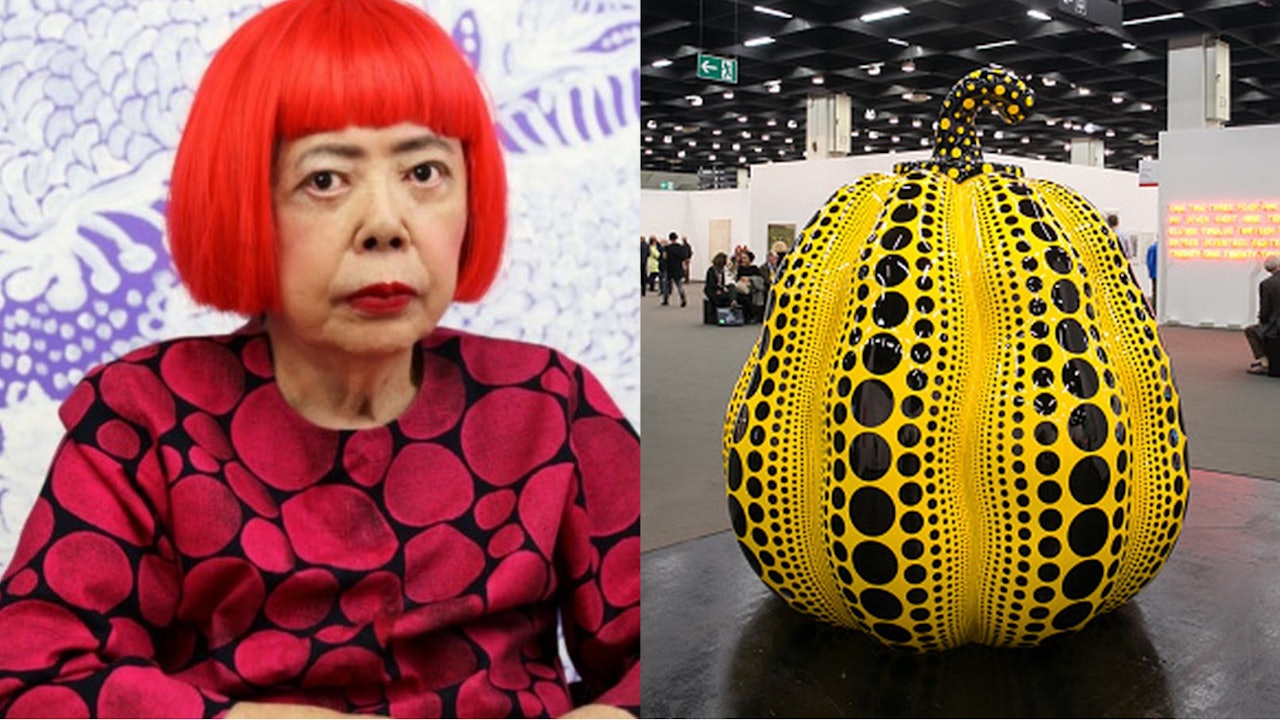
Yayoi Kusama spent nearly a century turning dots into a universe.
Now, that universe has lost its creator.
The legendary Japanese avant-garde artist, internationally known as the “Queen of Polka Dots,” died on August 14, 2026, at a hospital in Tokyo. She was 97.
Her death was officially announced on August 27 by the Yayoi Kusama Museum and Yayoi Kusama Foundation. Reports from Japanese media said the cause of death was multiple organ failure.
But there is one detail that makes the news especially emotional.
Kusama kept painting until the very end.
Her museum said she never put down her brush during her final days and remained committed to her lifelong belief in the power of art, love and hope.
For generations of art lovers, Kusama was far more than an artist.
She was a visual language.
A yellow pumpkin covered in black dots? Kusama.
A room filled with endless reflections? Kusama.
A canvas covered with thousands of repetitive marks? Kusama.
A sea of polka dots that seems to continue forever? Almost certainly Kusama.
Her work crossed the boundaries of contemporary art, fashion, design, architecture and popular culture.
And now, as the world looks back at her extraordinary life, one question keeps coming up:
How did a young Japanese artist who struggled with hallucinations and rejection become one of the most recognizable artists on Earth?
The News: Yayoi Kusama Has Died at 97
The announcement came more than a week after Kusama’s death.
According to the official statement, she died at a Tokyo hospital on August 14 at the age of 97. The museum described her as a pioneering avant-garde artist whose work extended across visual art, performance, fiction and poetry.
The timing of the announcement created an unusual moment.
While the world was only beginning to learn that Kusama had died, people were still visiting exhibitions devoted to her work.
Her Tokyo museum’s exhibition “KUSAMA’s POP” is continuing as scheduled through August 30.
Meanwhile, Kusama’s work is also being seen by visitors in Taiwan, where a major Japanese contemporary art exhibition featuring her work is scheduled to run through August 30.
Her physical presence may be gone.
But her art is still very much alive.
And so is the visual world she created.
Tim Cook Pays Tribute to a “True Visionary”
The reaction to Kusama’s death quickly spread far beyond the art world.
Apple CEO Tim Cook was among the prominent figures who publicly paid tribute.
Cook described Kusama as a “true visionary” and praised the artist’s “boundless imagination,” saying her creativity pushed the art world forward and left the world brighter and more vibrant.
That reaction says a lot about Kusama’s cultural reach.
You did not have to be a museum curator to know her work.
You could encounter Kusama through a painting, a giant pumpkin, a fashion collaboration, a social-media photo or an immersive mirror room.
Her art had escaped the traditional art world.
It had become part of everyday visual culture.
Why Is Yayoi Kusama So Famous?
Ask someone to name one contemporary Japanese artist, and there is a good chance Kusama’s name will come up.
Ask that same person what her art looks like, and they may immediately mention:
Dots.
But the dots are only the beginning.
Kusama built an entire artistic universe around repetition, infinity and the disappearance of the individual.
Her work often creates the sensation that there is no clear beginning or end.
A dot becomes another dot.
A reflection becomes another reflection.
A room becomes an infinite room.
One pumpkin becomes a field of pumpkins.
And suddenly, something ordinary becomes something almost cosmic.
That was one of Kusama’s greatest artistic achievements.
She could take the simplest visual idea and push it until it became overwhelming.
Her Dots Were Not Just Decoration
At first glance, Kusama’s polka dots can look playful.
Bright yellow.
Red.
White.
Black.
Purple.
Huge dots.
Tiny dots.
Dots covering walls, sculptures, clothing and entire rooms.
But the dots came from something much deeper.
Kusama experienced hallucinations from childhood.
She described seeing patterns and dots appear across surfaces and objects around her.
Instead of simply trying to escape those experiences, she turned them into art.
The result was extraordinary.
What might have been frightening became visually hypnotic.
What could have been a private struggle became a public language.
Her repetitive patterns became a way of confronting her own perception of reality.
This is one reason her work can feel both joyful and unsettling at the same time.
It looks colorful.
But underneath the color is a serious question:
Where does the individual end, and where does the universe begin?
A Childhood Marked by Hallucinations
Kusama was born in 1929 in Matsumoto, Nagano Prefecture, Japan.
She began making art as a child.
Her early life was not easy, and she experienced hallucinations that would later become central to her artistic identity.
Instead of treating these visions as something completely separate from her creative life, Kusama gradually incorporated them into her work.
Dots.
Nets.
Repetition.
Organic forms.
Infinite patterns.
These ideas became recurring themes throughout her career.
Her art was, in many ways, a method of survival.
She once described art as something that helped her continue living.
That makes the cheerful appearance of some of her later works even more striking.
Behind the bright colors was an artist who had spent decades wrestling with fear, obsession, isolation and the boundaries of perception.
She Left Japan for New York in 1957
One of the biggest turning points in Kusama’s life came when she left Japan for the United States in 1957.
She moved to New York and entered an art scene that was rapidly changing.
This was the era of Abstract Expressionism and the emergence of new forms of avant-garde art.
Kusama arrived as a young Japanese woman in a predominantly male American art world.
She had little reason to expect an easy path.
But she did something extremely difficult:
She created a style that was unmistakably her own.
Her early “Infinity Net” paintings became especially important.
Instead of painting a conventional image, Kusama covered canvases with countless repetitive marks.
The result could feel endless.
There was no obvious center.
No obvious ending.
Just repetition.
Again.
And again.
And again.
The idea was simple.
The effect was not.
The Artist Who Refused to Stay in One Box
Kusama never stayed comfortably inside a single category.
She painted.
She sculpted.
She created installations.
She staged performances.
She made films.
She wrote novels.
She wrote poetry.
She designed environments.
She experimented with fashion.
She challenged social conventions.
Her work moved through different artistic movements without fully belonging to any one of them.
She has been associated with pop art, minimalism, feminism and performance art, but none of those labels completely explains her.
That may be one reason her career lasted so long.
She kept changing the way people saw her.
In the 1960s, Kusama Was Far More Radical Than Her Polka Dots Suggest
Today, Kusama’s work is often associated with colorful museums and Instagram-friendly installations.
But her early career was much more provocative.
In 1960s New York, she staged controversial performances involving nudity, body painting and political protest.
She used her art to challenge war, social conventions and the male-dominated culture surrounding the art world.
One famous example was “Narcissus Garden,” presented at the 1966 Venice Biennale.
Kusama created thousands of mirrored spheres, turning reflection into both an artistic experience and a commentary on the art market and narcissism.
This is an important part of her story because it is easy to forget how radical she once was.
The woman behind the cheerful yellow pumpkins was once an artist deliberately provoking the establishment.
Then Came the Pumpkins
If the dots became Kusama’s signature, the pumpkin became her superstar.
Her pumpkin sculptures are now among the most recognizable works in contemporary art.
Perhaps the most famous image is the bright yellow pumpkin covered in black dots.
It is almost impossible to mistake for anyone else’s work.
Why a pumpkin?
For Kusama, pumpkins carried a personal warmth and familiarity.
She grew up in a family connected to plants and agriculture, and the humble pumpkin became a recurring subject in her artistic world.
But Kusama did not simply paint pumpkins.
She transformed them.
She enlarged them.
Covered them with dots.
Placed them in unexpected environments.
Turned them into sculptures.
And eventually made the pumpkin a global icon.
One of her most famous pumpkins sits on the Japanese art island of Naoshima, where it became a destination in its own right.
People travel specifically to see it.
That is the strange power of Kusama’s art.
She could take something ordinary and make it unforgettable.
The Infinity Mirror Rooms Changed the Museum Experience
Then there are the Infinity Mirror Rooms.
If the pumpkins made Kusama instantly recognizable, the mirror rooms made her art immersive.
Walk into one, and the rules change.
Instead of standing in front of a painting, you enter the artwork.
Mirrors multiply the space.
Lights repeat into the distance.
Objects appear to float endlessly.
Your own reflection becomes part of the installation.
Suddenly, you are no longer just looking at Kusama’s universe.
You are inside it.
This helped transform the museum experience for a new generation.
People who might never have considered themselves “art people” suddenly wanted to visit contemporary art museums.
They wanted to experience the room.
Take a photograph.
Stand inside the infinity.
Share the moment.
Kusama understood something incredibly important about modern audiences:
People don’t just want to look at art.
Sometimes they want to step inside it.
The Meaning Behind “Self-Obliteration”
One of the most important ideas in Kusama’s work is self-obliteration.
The phrase sounds dramatic, but it describes a recurring idea in her art.
Imagine a person covered entirely in dots.
Eventually, the body begins to disappear into the surrounding pattern.
The distinction between person and environment becomes blurred.
You are still there.
But you are also becoming part of everything around you.
That idea appears again and again in Kusama’s paintings and installations.
The individual becomes part of infinity.
This helps explain why repetition is so important.
A single dot is an individual object.
Millions of dots become an environment.
And an environment can become infinite.
She Returned to Japan — But Her Story Was Far From Over
Kusama returned to Japan in 1973.
A few years later, in 1977, she voluntarily entered a psychiatric hospital in Tokyo.
She continued to live there while working from a nearby studio.
For some artists, that might have marked the end of a career.
For Kusama, it became another chapter.
She continued creating.
She continued writing.
She continued developing her visual language.
Her daily routine became closely tied to her artistic practice.
Hospital.
Studio.
Painting.
Writing.
Repeat.
And repeat again.
That discipline became one of the defining characteristics of her life.
The World Eventually Came Back to Her
Kusama’s international reputation grew again in the 1980s and 1990s.
One of the biggest moments came in 1993, when she represented Japan at the Venice Biennale.
Her work was increasingly shown at major museums around the world.
Retrospectives introduced new generations to her earlier work.
Her Infinity Mirror Rooms became international attractions.
And suddenly, the artist who had once struggled to be fully recognized became impossible to ignore.
Her story was no longer simply about dots.
It was about persistence.
Her Art Became a Global Pop-Culture Phenomenon
Then something extraordinary happened.
Kusama became bigger than the contemporary art world.
Her signature style entered fashion and luxury culture.
Her collaboration with Louis Vuitton became especially famous, bringing her dots, pumpkins and psychedelic patterns into storefronts, bags, clothing and accessories.
Her work also became perfectly suited to the social-media era.
Infinity rooms were visually irresistible.
Colorful installations looked spectacular in photographs.
Visitors became part of the artwork.
And every new photograph effectively became another piece of Kusama publicity.
The internet did not simply spread her art.
It helped turn her into a global cultural icon.
From Avant-Garde Outsider to Global Brand
There is an interesting tension in Kusama’s later career.
The same artist who once challenged the commercial art world eventually became a major global brand.
Her work appeared in museums.
But also in fashion stores.
Her pumpkins became collectibles.
Her dots appeared on merchandise.
Her image became instantly recognizable.
Some critics have questioned whether mass popularity softened the radical edge of her earlier work.
That debate is part of her legacy.
But it also proves something important:
Kusama managed to make experimental contemporary art understandable to millions of people.
You didn’t need an art-history degree to enjoy a Kusama mirror room.
You didn’t need to know the history of minimalism to recognize her pumpkin.
You could simply walk in and feel something.
That accessibility was one of her greatest strengths.
A Record-Breaking Career
Kusama’s influence was also reflected in the art market.
Her paintings have sold for millions of dollars.
One of her “Infinity Nets” paintings sold for $10.5 million at auction in 2022, demonstrating the extraordinary market value attached to her work.
But money was never the most interesting part of her story.
The remarkable thing was how long she remained relevant.
Most artists are associated with one period.
Kusama continuously reinvented herself.
She could be discussed in the context of 1960s avant-garde art and still be one of the most photographed contemporary artists decades later.
That is rare.
Her Recognition Reached the Highest Levels
Kusama’s achievements were recognized both in Japan and internationally.
In 2016, she received Japan’s Order of Culture, one of the country’s highest honors for artists.
Her Tokyo museum opened in 2017, creating a permanent institution devoted to her work.
Major museums around the world continued to exhibit her art.
And even in 2026, shortly before her death, Kusama’s work was still drawing huge crowds.
The Museum Ludwig in Germany recently held an exhibition that attracted hundreds of thousands of visitors, while Amsterdam’s Stedelijk Museum announced that its upcoming Kusama retrospective would now be transformed into a tribute to her life and work.
Her career was not being remembered because it was finished.
It was still happening.
Until suddenly, it wasn’t.
Taiwan Has a Special Connection to Kusama
Kusama’s story also has a connection to Taiwan.
She visited Taiwan decades ago, and her work has continued to appear in Taiwanese exhibitions.
That makes the timing of her death especially striking.
As the world was mourning Kusama, audiences in Taiwan were still able to see her art in person.
The exhibition “When Flowers Bloom: Japanese Contemporary Art” at the Pingtung County Art Museum features Kusama alongside other major Japanese artists.
The exhibition is scheduled to run through August 30, 2026.
It brings together artists from different generations and explores Japanese art from the postwar period through contemporary culture.
Kusama’s presence is part of that larger story.
For visitors, however, the experience has now acquired an unexpected emotional dimension.
The artist has died.
Her artwork is still on the wall.
Why the Taiwan Exhibition Feels Different Now
Before Kusama’s death was announced, visitors could simply walk into the exhibition and think:
“That’s a Kusama.”
After August 27, the same work may feel completely different.
Because the person who created it is no longer here.
The dots are still there.
The colors are still there.
The shapes are still there.
But the context has changed.
An artwork that once felt like part of a living artist’s ongoing career has suddenly become part of art history.
And that is why the final days of the Taiwan exhibition may feel especially meaningful.
The exhibition is scheduled to close on August 30.
That means visitors have only a short window to see Kusama’s work there while the world is simultaneously processing the end of her extraordinary life.
Her Final Days Were Still About Art
Perhaps the most powerful detail in the official announcement is also the simplest:
She kept painting.
The Yayoi Kusama Museum said she continued to paint until her final days and never put aside her brush.
That sentence captures something fundamental about her.
Art was not simply her career.
It was how she organized her existence.
When the world was changing, she painted.
When the art world ignored her, she painted.
When she struggled with hallucinations, she painted.
When she became internationally famous, she painted.
When she was 97, she was still painting.
There is something almost poetic about that consistency.
What Will Kusama Leave Behind?
The obvious answer is:
Dots.
Pumpkins.
Infinity rooms.
But her real legacy is much bigger.
She showed that personal pain can become visual language.
She showed that repetition can become innovation.
She showed that an artist can remain strange without becoming irrelevant.
She showed that contemporary art can reach people far beyond museums.
And perhaps most importantly, she showed that an artist does not have to choose between serious art and popular culture.
Kusama managed to inhabit both worlds.
She could be discussed by art historians and photographed by teenagers.
She could influence avant-garde artists and luxury fashion.
She could be exhibited in major museums and become a social-media sensation.
Few artists have ever achieved that combination.
A Life That Became Its Own Infinity Room
Kusama’s life almost mirrors the structure of her art.
It began with a young girl in Matsumoto.
Then came Tokyo.
Then New York.
Then years of struggle.
Then Japan again.
Then international recognition.
Then global fame.
Then museums filled with visitors waiting to experience her infinite rooms.
And finally, at 97, the artist herself disappeared from the physical world.
But her work did not.
That is the strange thing about art.
The artist has an ending.
The artwork doesn’t necessarily have one.
A painting can be seen by someone who wasn’t even born when it was created.
A sculpture can stand beside the sea for decades.
A mirror room can make another generation feel as if they have stepped outside ordinary time.
A yellow pumpkin can become a symbol recognized around the world.
The “Queen of Polka Dots” Is Gone. The Dots Remain.
Yayoi Kusama spent decades trying to make the boundaries between self and universe disappear.
She covered canvases with dots.
She covered objects with dots.
She covered rooms with reflections.
She transformed pumpkins into monuments.
She turned her own hallucinations into a visual language that millions of people could understand.
And perhaps that is why her death feels so strange.
The artist is gone.
But her world is everywhere.
In museums.
On islands.
In photographs.
In fashion.
In architecture.
In books.
In the memories of people who once stood inside an Infinity Mirror Room and suddenly felt very small.
Or very large.
Or perhaps both at the same time.
Kusama’s life lasted 97 years.
Her artistic career stretched across more than seven decades.
But her central idea remained remarkably simple:
Keep creating. Keep repeating. Keep going.
The dots continue.
The reflections continue.
The pumpkins remain.
And somewhere inside that endless repetition is the artist herself.
Not physically.
But in the only way an artist can truly remain:
through the work.
Yayoi Kusama at a Glance
- Name: Yayoi Kusama
- Born: 1929, Matsumoto, Nagano, Japan
- Died: August 14, 2026
- Age: 97
- Place of death: Tokyo, Japan
- Reported cause of death: Multiple organ failure
- Known as: The “Queen of Polka Dots”
- Best known for: Polka-dot paintings, Infinity Nets, pumpkins and Infinity Mirror Rooms
- Major artistic fields: Painting, sculpture, installation, performance, film, fiction and poetry
- Moved to New York: 1957
- Represented Japan at: Venice Biennale, 1993
- Major honor: Japan’s Order of Culture, 2016
- Yayoi Kusama Museum: Opened in Tokyo in 2017
- Taiwan exhibition: “When Flowers Bloom: Japanese Contemporary Art”
- Pingtung exhibition: Scheduled through August 30, 2026
Yayoi Kusama is gone.
But her universe is not.
Look at a dot long enough, and it becomes a world.
Look at enough dots, and the world begins to look infinite.
That may be the most fitting legacy of all for the artist who spent her life painting toward infinity.