If you’re wondering “What time is the lunar eclipse tonight?”, you’re definitely not alone.
Millions of skywatchers across the Americas are looking up on the night of Thursday, August 27, into the early morning of Friday, August 28, 2026, as the Moon slides deep into Earth’s shadow.
And this isn’t an ordinary partial lunar eclipse.
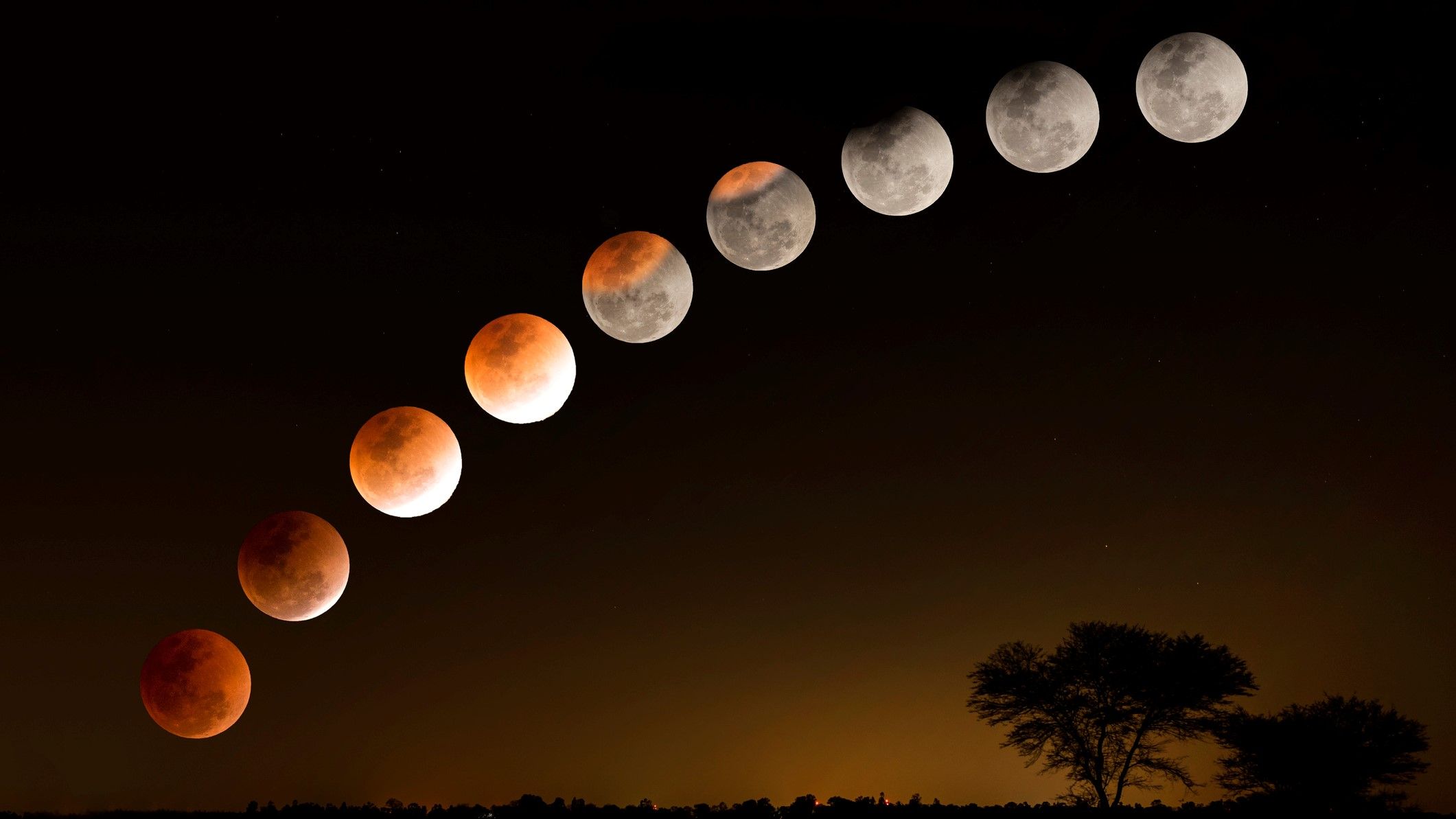
At its peak, about 96% of the Moon’s disk will be covered by Earth’s darkest shadow, making the event look remarkably close to a total lunar eclipse. Depending on local conditions, the Moon can take on dramatic shades of red, orange and copper—the reason many people are already calling it an “almost Blood Moon.”
The most important time to remember is 12:12 a.m. Eastern Time on Friday, August 28.
That is when the eclipse reaches its maximum.
NASA lists the peak at approximately 12:13 a.m. EDT, 9:13 p.m. PDT and 4:13 a.m. UTC.
But there is a catch: the eclipse lasts for hours, and the best viewing time depends heavily on where you live.
So before setting an alarm, here’s everything you need to know.
🌕 What time is the lunar eclipse tonight?
For viewers in the United States, the eclipse happens during the night of August 27 into August 28.
The first subtle stage begins when the Moon enters Earth’s outer shadow, but that early phase can be difficult to notice.
The real show begins when the Moon enters the darker part of Earth’s shadow.
According to eclipse calculations, the key worldwide times are:
| Eclipse stage | Time |
|---|---|
| Penumbral eclipse begins | 1:24 a.m. UTC |
| Partial eclipse begins | 2:34 a.m. UTC |
| Maximum eclipse | 4:13 a.m. UTC |
| Partial eclipse ends | 5:52 a.m. UTC |
| Penumbral eclipse ends | 7:02 a.m. UTC |
For New York and much of the U.S. Eastern Time Zone, that translates approximately to:
9:24 p.m. Thursday: Penumbral phase begins
10:34 p.m. Thursday: Partial eclipse begins
12:12 a.m. Friday: Maximum eclipse
1:52 a.m. Friday: Partial eclipse ends
3:02 a.m. Friday: Penumbral phase ends
The entire eclipse lasts about 5 hours and 38 minutes, although the most visually dramatic portion is much shorter.
The one time you really don’t want to miss
If you only have time to step outside once, aim for the period around:
12:12 a.m. EDT
That is the moment when the Moon is deepest inside Earth’s shadow.
At maximum eclipse, approximately 96.2% of the Moon’s surface area is inside the umbra, making the remaining bright portion look like a thin sliver beside a darkened, reddish Moon.
That is why this eclipse may look dramatically different from an ordinary partial eclipse.
🌑 Why is everyone calling it a “Blood Moon”?
Technically, tonight’s event is a partial lunar eclipse, not a total lunar eclipse.
That distinction matters.
During a total lunar eclipse, the entire Moon passes through Earth’s darkest shadow, or umbra.
Tonight, a tiny portion of the Moon remains outside the umbra.
But because the eclipse reaches roughly 96% obscuration, the Moon can look almost completely swallowed by darkness.
That is where the “almost Blood Moon” nickname comes from.
During the deepest part of the eclipse, the Moon may appear red, orange, copper or rusty brown.
The color comes from sunlight passing through Earth’s atmosphere.
Earth’s atmosphere filters and scatters sunlight before some of that light reaches the Moon. The longer-wavelength red and orange light can bend through the atmosphere and illuminate the lunar surface.
In other words, the Moon isn’t actually turning red.
It is being illuminated by sunlight that has effectively traveled through the edge of Earth’s atmosphere.
It is one of those astronomical events that sounds complicated but looks surprisingly magical.
🔥 How close is this to a total lunar eclipse?
Very close.
Very, very close.
NASA’s information puts the deepest portion of the eclipse at about 96.3% of the lunar disk within Earth’s umbra.
That means only a small portion of the Moon avoids the darkest part of the shadow.
For casual observers, the difference between a 96% partial eclipse and a total eclipse may not be immediately obvious.
The Moon can become extremely dark, while the eclipsed region takes on that familiar reddish glow associated with a Blood Moon.
This is why photos from tonight could be particularly dramatic.
A bright full Moon can normally overwhelm cameras with its glare.
But when most of the lunar surface becomes dark, the reddish portion can stand out much more clearly.
📍 Where can you see tonight’s lunar eclipse?
The eclipse is visible from a huge portion of the planet.
NASA says the August 27–28 partial lunar eclipse can be seen from the Americas, Africa, Europe and parts of the Pacific.
The Americas are especially well positioned because the eclipse occurs during nighttime hours across much of North and South America.
That includes large parts of:
- United States
- Canada
- Mexico
- Central America
- Caribbean
- South America
Parts of Europe and Africa can also see portions of the event, depending on local Moonrise, Moonset and daylight conditions.
However, visibility isn’t identical everywhere.
A city might technically be inside the eclipse’s visibility zone but still have a poor view because the Moon is low on the horizon, clouds block the sky or the eclipse occurs near sunrise or sunset.
That is why local timing matters.
🇺🇸 U.S. eclipse times: the best viewing window depends on your time zone
If you’re in the United States, the maximum occurs at different clock times depending on your location.
Eastern Time
For cities such as New York and Washington, D.C.:
Partial eclipse begins: about 10:34 p.m. Thursday
Maximum: about 12:12 a.m. Friday
Partial eclipse ends: about 1:52 a.m. Friday
This is one of the best regions for watching the entire event.
In New York, for example, the Moon remains above the horizon throughout the eclipse under suitable weather conditions.
Central Time
For places such as Chicago and much of the central United States, the maximum occurs at approximately:
11:12 p.m. Thursday
The eclipse begins earlier in the evening and continues into the early hours of Friday.
Mountain Time
For viewers in the Mountain Time Zone, the peak occurs at approximately:
10:12 p.m. Thursday
That makes the event particularly convenient for people who don’t want to stay awake until midnight.
Pacific Time
For Los Angeles and much of the West Coast, the maximum occurs at approximately:
9:12 p.m. Thursday
NASA gives the peak as approximately 9:13 p.m. PDT.
That means West Coast viewers have a major advantage: the most dramatic portion happens relatively early in the evening.
No 2 a.m. alarm required.
🌎 What about Canada, Mexico and South America?
The same eclipse is crossing much of the Western Hemisphere, but local times vary.
For example, viewers farther west will see the maximum earlier in their evening, while locations farther east will experience it later.
The exact viewing experience also depends on the Moon’s altitude.
If the Moon is high in the sky, the event should be much easier to watch.
If it is close to the horizon, buildings, trees, mountains and atmospheric haze can interfere.
The best strategy is simple:
Check your local eclipse time and look for an unobstructed view of the Moon.
Interactive eclipse maps can provide location-specific timing and visibility information.
🌕 What will the Moon actually look like?
This is where tonight could get interesting.
At first, you may not notice much.
The Moon will gradually enter Earth’s penumbra, the lighter outer portion of the shadow. This phase is subtle and can be difficult to see with the naked eye.
Then the darker shadow begins crossing the lunar surface.
This is when things become much more obvious.
You may see a dark “bite” appear along one edge of the Moon.
As the eclipse progresses, the dark region expands.
Eventually, nearly the entire Moon is buried inside Earth’s umbra.
The remaining illuminated portion can become intensely bright by comparison, while the shadowed section may glow with reddish or copper tones.
At maximum eclipse, the Moon may look almost like a glowing ember floating in the night sky.
And because roughly 96% of the Moon is inside the darkest shadow, the visual effect could be surprisingly close to a total lunar eclipse.
📸 Do you need special equipment?
No.
One of the best things about a lunar eclipse is that it is extremely easy to observe.
Unlike a solar eclipse, you do not need special eclipse glasses to look at the Moon.
You can simply go outside and look up.
Binoculars can make the event more interesting, especially when the Moon is partially eclipsed.
A telescope can reveal even more detail.
But neither is necessary.
If you’re using a smartphone, don’t expect the Moon to automatically look as impressive in your photo as it does to your eyes.
The Moon is small in the sky, and phone cameras often struggle with extremely dark scenes.
A tripod or stable surface can help.
If your phone allows manual camera controls, experiment with exposure and focus.
And don’t be afraid to take multiple photos.
The sky will keep changing as the shadow moves across the Moon.
☁️ The biggest problem tonight may not be the eclipse—it may be the weather
Astronomically, the eclipse is happening whether we can see it or not.
But clouds don’t care.
Across the United States, local weather conditions will determine whether individual communities get a spectacular view or a completely blocked sky.
Some cities are expected to have favorable viewing conditions, while others may deal with clouds or storms.
That means checking your local forecast shortly before the eclipse can be just as important as knowing the eclipse time.
If the forecast looks cloudy at your home, don’t automatically give up.
A short drive to an area with clearer skies may make a huge difference, assuming local travel conditions are safe.
The ideal viewing location is:
Dark + open + clear + unobstructed.
You don’t need to travel to a remote mountain.
A backyard, park or open field can work.
Just make sure trees and buildings aren’t blocking the Moon.
👀 What are the five major moments to watch?
If you want to experience the eclipse instead of simply checking the Moon once, follow its progression.
1. Penumbral eclipse begins
Earth’s outer shadow starts moving across the Moon.
This is the least dramatic stage.
You may notice a subtle darkening, but don’t expect an obvious visual change immediately.
2. Partial eclipse begins
This is when the real show starts.
The Moon enters Earth’s umbra and a dark shadow begins covering part of the lunar disk.
This is the moment photographers should start paying attention.
3. Maximum eclipse
This is the big one.
At around 12:12 a.m. EDT, the Moon reaches maximum eclipse.
About 96% of its disk is inside Earth’s umbra.
This is also when the reddish or copper appearance can become most dramatic.
4. Partial eclipse ends
The Moon begins leaving the darkest portion of Earth’s shadow.
The bright lunar surface gradually returns.
5. Penumbral eclipse ends
The Moon finally exits Earth’s outer shadow.
The eclipse is officially over.
The complete sequence takes several hours.
🌕 Is tonight’s eclipse the same as a total Blood Moon?
No—and that’s an important detail.
You may see headlines describing this as a “Blood Moon,” but scientifically, tonight’s event is a deep partial lunar eclipse.
The Moon does not become 100% covered by Earth’s umbra.
Instead, approximately 96% is covered.
That’s why terms such as “almost Blood Moon” or “near-total lunar eclipse” are being used in media coverage.
Still, the distinction doesn’t make the event less interesting.
A 96% partial eclipse is visually impressive.
And for many casual skywatchers, the experience will feel remarkably similar to watching a total lunar eclipse.
🌌 Why is this eclipse happening so soon after the solar eclipse?
There is a fascinating astronomical connection.
The August 2026 lunar eclipse comes only a couple of weeks after the August 12, 2026 total solar eclipse.
That isn’t a coincidence.
Solar and lunar eclipses occur around the same general period because they require the Sun, Earth and Moon to line up closely enough for shadows to fall in the right places.
An eclipse season lasts roughly 35 days, creating a window in which multiple eclipses can occur.
The August 12 total solar eclipse and the August 27–28 partial lunar eclipse are therefore part of the same broader eclipse season.
For astronomy fans, that makes August 2026 an especially memorable month.
First, the Moon’s shadow crossed Earth during the solar eclipse.
Now Earth’s shadow is crossing the Moon.
🐟 What is the Sturgeon Moon?
Tonight’s eclipse also coincides with the August full Moon, commonly known as the Sturgeon Moon.
The name comes from traditional seasonal naming practices associated with the time of year when sturgeon were historically easier to catch in parts of North America.
Because the Moon is full, the lunar disk is positioned perfectly for an eclipse.
A lunar eclipse can only happen during a full Moon.
But not every full Moon produces an eclipse.
The Moon’s orbit is tilted relative to Earth’s orbit around the Sun, so most full Moons pass above or below Earth’s shadow.
Tonight, the geometry lines up.
And that’s when the spectacle happens.
🌎 Can people in Europe and Africa see it?
Yes, at least portions of the eclipse are visible from parts of Europe and Africa.
But the timing can be less convenient than in North America.
Some locations may see the Moon during the eclipse only shortly after Moonrise or before Moonset.
Others may experience only part of the eclipse.
Timeanddate’s global visibility data shows portions of the eclipse visible across Europe, Africa, North America and South America, as well as parts of other regions.
For viewers outside the Americas, the exact local circumstances become especially important.
🇹🇼 What about Taiwan and East Asia?
Here’s the catch for Asian skywatchers.
The most favorable viewing area is centered on the Americas.
For Taiwan and much of East Asia, the August 27–28 eclipse is not positioned as a convenient nighttime event.
In other words, simply knowing that the eclipse is happening on August 28 does not mean everyone around the world can step outside that night and see it.
This is one reason eclipse stories can become confusing online.
The same astronomical event can happen on one calendar date in one country and a different local date—or during daylight—in another.
Always use your own location when checking eclipse visibility.
🔭 Do you need eclipse glasses?
No.
This is one of the easiest astronomical events to watch safely.
A lunar eclipse involves looking at the Moon, not directly at the Sun.
Unlike solar eclipses, there is no need for certified solar-viewing glasses.
You can watch the Moon with your naked eyes.
Binoculars are optional.
A telescope is optional.
A camera is optional.
The only thing you really need is a reasonably clear sky.
📱 How to watch the lunar eclipse if clouds ruin your view
If clouds move in at exactly the wrong moment, don’t panic.
Major astronomy and science outlets often provide livestream coverage of significant eclipses.
That can be especially useful for people living in locations where the eclipse isn’t visible.
You can also follow real-time updates from astronomy news organizations as the eclipse progresses.
But if your sky is clear, watching the real Moon is still the better experience.
There’s something different about standing outside and seeing Earth’s shadow physically move across another world.
No screen can quite reproduce that feeling.
⏰ What time should you set your alarm?
If you’re in the United States, the answer depends on your time zone.
But if you’re looking for the simplest possible cheat sheet:
Eastern Time: around 12:12 a.m. Friday
Central Time: around 11:12 p.m. Thursday
Mountain Time: around 10:12 p.m. Thursday
Pacific Time: around 9:12 p.m. Thursday
The partial eclipse begins roughly 1 hour and 40 minutes before maximum and continues for about another 1 hour and 40 minutes afterward.
So you don’t have to hit the exact minute.
If you’re outside, give yourself at least 20–30 minutes around the peak.
That way, you’ll see the Moon before, during and after maximum eclipse.
🚨 Don’t make this mistake: “partial” does not mean boring
The phrase “partial lunar eclipse” may sound underwhelming.
It shouldn’t.
A shallow partial eclipse can indeed be subtle.
But this one reaches approximately 96% coverage.
That’s an entirely different experience.
The Moon will spend a significant amount of time deeply embedded in Earth’s shadow, potentially producing a dramatic red-orange appearance.
NASA’s visualization describes it as a deep partial eclipse, with the Americas centrally positioned for observation.
So if you see someone say, “It’s only partial, skip it,” they’re missing the most important detail.
This is a very deep partial eclipse.
🌃 The best way to watch tonight
You don’t need an elaborate astronomy setup.
Try this instead:
1. Find an open location.
Get away from tall buildings and trees.
2. Check the weather.
Clear skies are more important than expensive equipment.
3. Give your eyes time to adjust.
Avoid staring at bright phone screens continuously.
4. Start watching before maximum.
You’ll see Earth’s shadow gradually consume the Moon.
5. Look again around maximum.
This is when the Moon should look most dramatic.
6. Take a few photos—but don’t watch the whole thing through your phone.
The real event is happening above you.
Sometimes the best photograph is the one you don’t take.
🌕 The bigger reason this eclipse matters
Astronomical events have a funny way of making people stop scrolling.
For a few minutes, everyone is looking at the same thing.
Tonight’s eclipse is particularly interesting because it sits in that sweet spot between a routine sky event and a spectacular total eclipse.
It’s not technically total.
But with roughly 96% of the Moon entering Earth’s darkest shadow, it comes remarkably close.
And for people in North and South America, the timing is unusually convenient.
The eclipse occurs during the evening or early morning, rather than requiring an impossible pre-dawn wake-up in many locations.
That’s a big reason astronomy outlets are encouraging people to get outside.
⭐ Final answer: What time is the lunar eclipse tonight?
If you’re in the United States and simply want the most important answer:
The August 27–28, 2026 lunar eclipse reaches maximum at about 12:12 a.m. Eastern Time on Friday, August 28.
That corresponds to approximately:
11:12 p.m. CDT
10:12 p.m. MDT
9:12 p.m. PDT
The partial eclipse itself begins earlier and continues afterward.
At maximum, approximately 96% of the Moon will be inside Earth’s umbra, creating a deep partial eclipse that may give the Moon a striking red or copper appearance.
And yes—you can watch it with your naked eyes.
No telescope.
No special glasses.
No complicated setup.
Just find a place with a clear view of the sky, step outside and look up.
Because sometimes the best show of the night is the one happening millions of miles above your head.