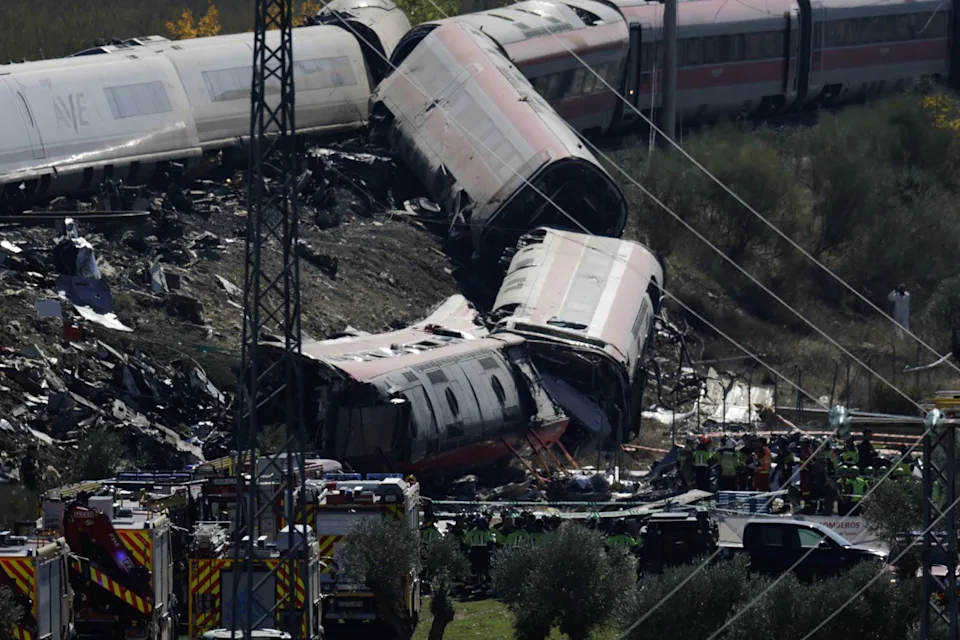
At least 68 people have been reported dead after a devastating high-speed train collision in Spain. Three recordings of conversations between train drivers and railway controllers are now drawing attention to the 17 minutes before the crash. Here’s what happened, what investigators are examining, and what remains unknown.
A high-speed train collision in central Spain has left dozens dead and raised urgent questions about railway safety.
The crash occurred at approximately 8:53 a.m. local time on October 28, 2026, near Urda, in Spain’s Toledo province.
Two trains were involved: an AVE high-speed train operated by Spain’s national railway company, Renfe, and a train operated by private railway company Iryo.
According to initial reports, the Iryo train had stopped after experiencing a technical problem. The following AVE train subsequently collided with it.
The impact was devastating. Several carriages derailed, some were severely crushed, and parts of the wreckage fell down an embankment. Emergency crews worked to reach trapped passengers and search the damaged carriages.
At least 68 people were reported dead as of October 29, with numerous others injured. The casualty figures may change as authorities continue their work.
But beyond the scale of the disaster, one question stands out:
Why was the train behind reportedly instructed to resume normal operations while the train ahead was still unable to restart?
Three recordings of communications between train drivers and railway controllers have become important pieces of evidence. Investigators are examining the technical failure, the instructions issued by the control center, and whether the required safety procedures were followed.
Here’s what we know so far.
What Happened in the Spain High-Speed Train Crash?
The collision occurred on a high-speed railway route connecting Madrid with southern Spain.
The two trains involved were operated by different companies:
- Renfe AVE: Spain’s national high-speed rail service.
- Iryo: A private railway operator offering high-speed services in Spain.
Initial reports indicate that the Iryo train stopped following a technical problem affecting railway operations. The following AVE train then collided with it.
The collision caused extensive damage, with carriages derailing and some falling down an embankment.
Rescue workers faced the difficult task of reaching passengers trapped inside twisted metal and damaged train cars. Heavy equipment was also needed to help clear the wreckage.
Authorities continued investigating the circumstances of the crash on October 29.
Two major questions are at the center of the investigation:
- What caused the technical failure?
- Why did the following train continue toward a section of track where another train was reportedly stationary?
The answers may depend on the precise sequence of communications, the condition of the railway control systems, and the instructions given to both drivers.
The Crucial 17 Minutes Before the Collision
Three reported recordings have helped bring attention to the minutes leading up to the crash.
The conversations reportedly show how the control center responded to technical problems and how the drivers communicated the condition of their trains.
Here’s the preliminary timeline based on the reported communications.
8:30 a.m. — A Technical Problem Disrupts Operations
A technical problem affects the railway control system, disrupting normal operations.
When a railway control system experiences a fault, train movements may need to be restricted while operators establish the condition of the line.
The control center must understand where trains are located, whether the relevant sections of track are occupied, and which safety procedures apply before normal operations can resume.
However, the initial technical problem alone does not explain why the collision occurred.
Investigators must establish what failed, how the system responded, and whether the required backup procedures were followed.
8:36 a.m. — The Following Train Is Told to Resume Running
One of the reported recordings involves a conversation between the control center and the driver of the following AVE train.
According to published accounts, the controller instructed the driver to disconnect and reconnect the train’s control system before resuming operations.
The driver reportedly asked for confirmation and received an affirmative response.
This exchange has become a major focus because investigators need to establish what information the controller had about the railway line at that moment.
Was the location of the train ahead known?
Had the relevant section of track been confirmed safe?
Were special operating procedures required because of the technical failure?
These questions cannot be answered by the conversation alone. Investigators will need to compare the recording with train-location data, signaling records, and system logs.
8:41 a.m. — The Iryo Train Reports That It Cannot Restart
Another reported communication involves the driver of the Iryo train.
The driver reportedly informed the control center that the train had stopped near Urda and could not resume normal operations.
According to published accounts, attempts to resolve the problem did not immediately succeed.
This created an important situation: the following AVE train had reportedly received instructions to resume running, while the Iryo train ahead was still experiencing problems.
Being authorized to move, however, does not automatically mean that the track ahead is clear.
Investigators will need to establish what the control center knew about the two trains, how that information was handled, and whether the relevant safety checks were completed.
8:48 a.m. — The Iryo Driver Reports Another Problem
A third reported recording captures another communication before the collision.
The Iryo driver reportedly contacted the control center again, explaining that the train still could not restart.
About five minutes later, at approximately 8:53 a.m., the collision occurred.
This short interval has intensified questions about the information available to railway controllers and the procedures used to manage the technical failure.
However, the recordings represent only part of the evidence.
To reconstruct the accident accurately, investigators will need to examine the complete communications, train speeds, signaling information, control-system records, and the actions taken by everyone involved.
Did the Railway Control Center Make a Mistake?
Spain’s transport minister, Óscar Puente, has publicly questioned the instructions given during the incident.
The reported communications have raised concerns about whether the decision to resume normal operations was appropriate while the railway system was experiencing problems.
But an important distinction must be made: questions about a decision are not the same as a final determination of responsibility.
Railway operations depend on several layers of protection working together.
These can include signaling systems, train-control technology, speed restrictions, communications between drivers and controllers, and procedures for operating during technical failures.
When one system fails, the remaining safeguards must help prevent a dangerous situation from developing.
Depending on the railway system and the circumstances, emergency procedures may require reduced speeds, additional authorization, checks of the track ahead, or other precautions.
Investigators must determine which rules applied to the trains involved and whether those requirements were followed.
The investigation will focus on several questions:
- What caused the original technical problem?
- What information did the control center have when it authorized the following train to resume operations?
- Was the stationary train correctly identified and tracked?
- Were the relevant operating restrictions communicated to the driver?
- Did the signaling and train-protection systems function as intended?
- Could another safety measure have prevented the collision?
Until the technical evidence has been examined, it would be premature to attribute the entire disaster to one person or one decision.
Why Three Audio Recordings Matter
The recordings are important because they may help investigators reconstruct how information moved through the railway system before the collision.
In a serious rail accident, the timeline of decisions can be just as important as the physical damage.
A recording may establish what a driver reported, what a controller instructed, and when a particular exchange occurred.
But investigators must also determine what was happening outside the conversation.
For example, a controller’s understanding of a train’s location may depend on signaling displays, automated tracking systems, and information received from other personnel.
A driver may receive an instruction without having access to the full operational picture available to the control center.
This is why investigators typically compare recordings with technical records rather than relying on a single conversation.
The goal is to reconstruct the sequence of events as accurately as possible and determine whether any failure in communication, equipment, or procedure contributed to the crash.
Spain’s Railway Safety Under Renewed Scrutiny
The collision has raised broader questions about railway safety in Spain.
The country operates an extensive high-speed rail network connecting major cities, including Madrid, Barcelona, Seville, and Valencia.
High-speed trains allow passengers to travel long distances quickly, but the system depends on reliable equipment, effective maintenance, and strict operating procedures.
A major accident can prompt questions about whether existing safety measures are sufficient, particularly when equipment problems occur.
However, a single accident does not automatically establish that an entire railway network is unsafe.
To determine whether wider problems exist, investigators and regulators need to examine maintenance records, equipment failures, operating procedures, and the effectiveness of safety systems.
The most important outcome will be identifying specific weaknesses and making changes that can reduce the risk of another tragedy.
Spain Declares Three Days of Official Mourning
Spain announced three days of official mourning from October 29 through October 31 following the disaster.
Prime Minister Pedro Sánchez said the government would investigate the crash and prioritize assistance for victims and their families.
Emergency workers continued dealing with the aftermath, including searching damaged carriages, assisting injured passengers, and recovering victims.
The scale of the damage made the rescue operation especially difficult in areas where carriages had been severely deformed or had fallen down an embankment.
As authorities work to establish what happened, the immediate priority remains supporting survivors and the families of those who died.
Are High-Speed Train Services in Spain Affected?
The accident has disrupted high-speed rail services connecting Madrid with parts of southern Spain.
Passengers planning to travel through affected sections should check the latest information from their railway operator before heading to the station.
Depending on the route and the extent of the disruption, travelers may face cancellations, replacement transport, or longer journey times.
Passengers with existing reservations should confirm whether their trains are operating and check the rules for changing or canceling tickets.
Travelers should rely on official railway announcements for current service information rather than assuming normal schedules have resumed.
Because this is a developing situation, service information may change as railway operators assess the damage and restore operations.
Is There a Safest Seat on a High-Speed Train?
After a serious train accident, many passengers naturally wonder whether sitting in a particular carriage or seat could improve their chances of survival.
Some discussions of railway safety suggest that the middle of a train may be less exposed in certain types of collision than the front or rear.
However, there is no universally safest seat for every train accident.
The outcome depends on several factors, including the type of collision, the direction and force of the impact, whether the train derails, the design of the carriages, and where the damage occurs.
A position that offers an advantage in one type of accident may not provide the same protection in another.
Passengers should therefore be cautious about claims that a particular seat guarantees greater safety.
More practical precautions include:
- Following onboard safety instructions.
- Keeping luggage securely stored.
- Paying attention to announcements from train staff.
- Following crew instructions during an emergency.
- Avoiding unnecessary movement through the train when conditions become unsafe.
These steps cannot eliminate every risk, but they can help passengers respond more effectively to unexpected situations.
What Investigators Still Need to Establish
As of October 29, the reported recordings provide important clues about the events before the collision, but the full cause remains under investigation.
Several questions remain unanswered.
What caused the technical failure?
Investigators need to determine whether the problem originated in the control system, communications equipment, or another part of the railway infrastructure.
Why was the following train instructed to resume operations?
The investigation must establish what information was available to the control center and whether the instructions complied with the applicable operating rules.
Did the safety systems work as intended?
Technical experts will need to examine the signaling, train-control, and protection systems to determine what safeguards were available and how they operated.
Could the collision have been prevented?
This will require a detailed reconstruction of train movements, communications, and the decisions made in the minutes before impact.
What changes are needed to prevent another disaster?
The findings may lead to changes in equipment, maintenance, emergency procedures, staff training, or railway operating rules.
The answers will depend on the full body of evidence, not just the recordings that have already been reported.
The Bottom Line
Spain’s high-speed train collision has left at least 68 people reported dead and raised urgent questions about railway safety.
The most troubling detail so far is the reported sequence of communications: the train ahead remained unable to restart, while the following train had been instructed to resume normal operations.
Three recordings are helping investigators reconstruct the final minutes before the collision.
But the recordings are only one part of the investigation.
Authorities still need to establish what caused the technical failure, what information was available to railway controllers, whether the required safety procedures were followed, and how the different safety systems performed.
For the victims and their families, the immediate priority is support and assistance.
For everyone who relies on rail travel, the hope is that the investigation will produce clear answers and practical improvements that help prevent another tragedy.