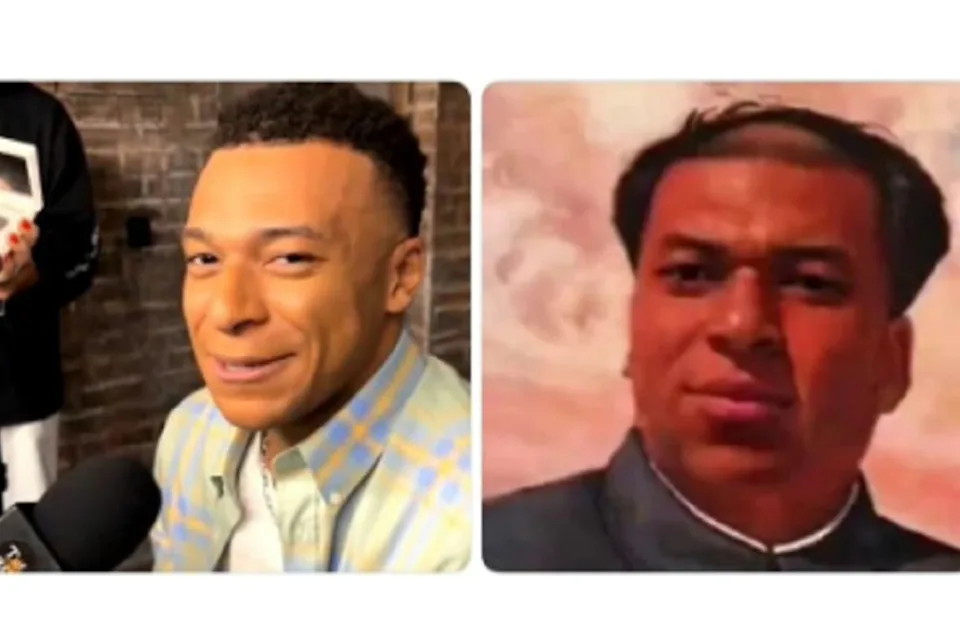
Real Madrid superstar Kylian Mbappé has found himself at the center of an unexpected controversy in China—not because of anything that happened on the football pitch, but because of an internet meme.
During an interview on the online show The Bridge, the French footballer discussed his favorite memes, revealing that he particularly enjoyed an edited image featuring his own face superimposed onto Mao Zedong, the founding leader of the People’s Republic of China.
Mbappé also reportedly said he regularly shared the image with friends while playing PlayStation online.
The controversy escalated after he referred to the historical figure as a Chinese dictator. The comments triggered criticism from Chinese internet users and prompted a response from Chinese sports media outlet Dongqiudi, which said it would not translate the interview.
On October 27, 2026, Chinese beverage brands Eastroc Beverage and Mengniu were also reported to have ended their partnerships with the football star.
What started as a conversation about internet humor has turned into a broader debate about political sensitivity, cultural differences, celebrity endorsements, and the risks international stars face when their off-field comments cross cultural boundaries.
What Did Mbappé Actually Say?
The controversy began when Mbappé appeared on The Bridge, where he discussed internet memes featuring himself.
Memes are a familiar part of modern football culture. Fans routinely turn players’ facial expressions, celebrations, mistakes, and personal lives into jokes that spread across social media.
Mbappé is no stranger to this phenomenon. His performances and public image have inspired countless edited images and humorous posts.
During the interview, he mentioned a meme that superimposed his face onto the image of a Chinese political leader.
According to circulating clips and media reports, Mbappé described the figure as a Chinese dictator and said he often shared the image with friends while playing PlayStation.
The comments quickly attracted attention because the image involved Mao Zedong, a figure with enormous historical and political significance in China.
However, there is an important distinction between discussing a meme and making a detailed political statement.
The available interview excerpts focus on Mbappé’s enjoyment of the image as internet humor. They do not, by themselves, establish that he intended to deliver a broader political message or deliberately insult Chinese people.
That distinction has become central to the debate surrounding the incident.
Why Did the Mao Zedong Meme Trigger Such a Strong Reaction in China?
For many international football fans, the exchange might appear to be an ordinary conversation about online jokes.
In China, however, Mao Zedong occupies a particularly significant place in the country’s political history and official historical narrative.
He was a leading figure in the founding of the People’s Republic of China in 1949 and remains an important, though historically contested, figure in Chinese politics.
As a result, images involving Mao can carry meanings that extend far beyond ordinary internet humor.
The controversy involves two separate elements: the use of Mao’s image in a joke and the description of him as a dictator.
Some Chinese internet users interpreted the combination as disrespectful toward an important historical figure and, by extension, China’s national identity.
Others may see the incident primarily as an example of the way internet memes cross cultural boundaries, often without their creators or users fully considering how they will be received elsewhere.
These interpretations are not necessarily mutually exclusive.
A person can view an image as a joke without intending to offend an entire country. At the same time, audiences are not obligated to find that joke acceptable simply because it was intended to be humorous.
The central issue is the gap between the context in which a meme is shared and the meaning it acquires when viewed through a different cultural and political lens.
Chinese Sports Media Outlet Dongqiudi Responds
The controversy moved beyond social media when Dongqiudi, a Chinese sports media platform, publicly addressed the interview.
According to media reports, the outlet said it would not translate the relevant content because the remarks were considered hurtful to China and the Chinese people. It also called on fans to watch football rationally and avoid inappropriate comments.
The response added another dimension to the story.
Sports interviews are usually intended to offer insights into players’ personalities, routines, opinions, and lives outside football. But when a conversation touches on politically sensitive subjects, media organizations may decide that translating or republishing the material is inappropriate.
Dongqiudi’s decision does not establish that all Chinese media outlets have taken the same position. Nor does it prove that Mbappé’s matches, football coverage, or other content will be universally blocked in China.
What it does demonstrate is that the interview had moved beyond a routine discussion of football memes and become a subject of public debate within China’s sports media environment.
Eastroc Beverage Ends Its Partnership With Mbappé
The most significant development came from the commercial side.
Eastroc Beverage, a major Chinese beverage company, had previously partnered with Mbappé to promote its electrolyte drink brand, Busu La.
The partnership was announced on April 20, 2026, positioning the French star as a prominent face of the brand.
For beverage companies, international footballers offer an attractive combination of global recognition, athletic credibility, and access to younger consumers. A well-known player can help a product stand out in a competitive market.
But celebrity endorsements also create risks.
When a public figure becomes involved in a controversial incident, the attention surrounding that person can quickly shift from a marketing advantage to a potential public relations problem.
On October 27, Eastroc Beverage announced that it was ending all cooperation with Mbappé, according to reports about the company’s response to the controversy.
The decision marked a significant change in the relationship between the footballer and the Chinese market.
Rather than remaining a debate about whether a particular meme was offensive, the incident had begun to affect an actual commercial partnership.
For brands that depend heavily on domestic consumer trust, a controversy involving national identity or historical sensitivities can create difficult decisions.
Continuing a partnership may expose a company to criticism, while ending it can mean losing the benefits of an expensive celebrity endorsement.
Eastroc’s reported decision illustrates how quickly those considerations can come into play.
Mengniu Also Ends Its Partnership With the Football Star
Eastroc was not the only company associated with the controversy.
Chinese dairy company Mengniu was also reported on October 27 to have ended all cooperation with Mbappé.
Reports described the move as part of the wider response to the remarks and the concerns they raised among Chinese audiences.
The involvement of two major brands significantly increased the commercial stakes.
However, it is important to distinguish between the termination of individual endorsement agreements and a broader ban on a footballer.
Mbappé’s club contract with Real Madrid is separate from his personal endorsement agreements. Likewise, commercial partnerships in China are distinct from deals he may have with companies in other countries.
The reported decisions by Eastroc and Mengniu do not automatically mean that all of Mbappé’s global sponsors will follow suit.
Details such as the financial value of the terminated agreements, potential penalties, and the treatment of existing advertising materials have not been fully established in the information available.
Those details should not be assumed without further confirmation from the companies or the parties involved.
The Internet Meme Behind the Controversy
The Mao Zedong image was not the only example of the internet’s tendency to turn Mbappé into a meme.
Footballers are frequent subjects of online parody, and Mbappé’s public image has inspired various edited pictures, exaggerated character portrayals, and jokes.
One recurring theme is the so-called “Dictator Mbappé” meme, in which the footballer is edited into the appearance of an authoritarian leader or portrayed as an unusually powerful, controlling figure.
These images typically rely on exaggeration rather than historical accuracy. Their humor comes from the contrast between a real athlete and an absurd fictional persona.
In online communities, a meme can become popular precisely because it is recognizable, reusable, and detached from its original context.
Mbappé’s comments suggest that he viewed at least one of these images as an amusing part of his online interactions with friends.
But a meme that feels harmless within one online community can carry a very different meaning elsewhere.
That is particularly true when a joke incorporates a historical figure whose image is closely associated with national identity, political ideology, or collective memory.
For Mbappé, the image may have been a piece of internet humor. For some Chinese viewers, the same image and the language used to describe it represented a more serious form of disrespect.
The controversy highlights a familiar problem in global internet culture: jokes travel internationally much faster than the cultural context needed to understand them.
Why Celebrity Endorsements Can Become a Liability
The Mbappé incident also highlights a challenge faced by multinational brands that rely on celebrity ambassadors.
A major sports star can provide enormous marketing value. Fans recognize the player’s face, associate the athlete with success and performance, and may become more interested in products connected to that person.
However, the same visibility can magnify controversy.
For brands operating in markets where historical memory and national identity play important roles in public life, a celebrity’s comments can quickly become a business issue.
Companies must weigh several factors:
- Consumer sentiment: Could the controversy affect customers’ willingness to support the brand?
- Brand reputation: Could continued cooperation be interpreted as indifference toward public concerns?
- Contractual obligations: What options are available under the existing endorsement agreement?
- Commercial value: Does the long-term benefit of the partnership outweigh the reputational risks?
- Public communication: How should the company explain its decision to customers and business partners?
These considerations do not mean every controversy should automatically result in a terminated contract.
They do help explain why companies sometimes respond quickly when an ambassador’s public image becomes politically or culturally contentious.
In Mbappé’s case, the reported decisions by Eastroc and Mengniu show how an off-field interview can have consequences that extend well beyond football.
Mbappé’s Golden Ball Headlines Take a Back Seat
The controversy emerged during a week when Mbappé was already attracting attention for his football career.
The 2026 Ballon d’Or ceremony took place in London on October 26. According to reports published the following day, England striker Harry Kane won the award, finishing ahead of competitors including Mbappé and Lamine Yamal.
The Ballon d’Or is one of football’s most prestigious individual honors, making the ceremony a major event for players, clubs, and fans.
Yet Mbappé’s name soon became associated with a different story.
Instead of focusing exclusively on his performances and individual accolades, media coverage turned toward his comments about the meme and the consequences for his commercial partnerships in China.
This shift illustrates the complicated relationship between athletic success and public image.
For international stars, reputation is built not only through performances on the pitch but also through interviews, social media activity, advertising campaigns, and interactions with fans.
A single controversial exchange can sometimes overshadow months of sporting discussion, particularly when it involves a major consumer market.
Will Mbappé Apologize? What Happens Next?
As of October 27, 2026, the main developments reported in connection with the controversy include:
- The interview: Mbappé discussed a meme featuring his face superimposed onto the image of a Chinese political leader.
- Media reaction: Chinese sports platform Dongqiudi said it would not translate the relevant remarks.
- Eastroc Beverage: The company announced that it was ending its cooperation with Mbappé.
- Mengniu: The company was also reported to have ended its partnership with the footballer.
Several questions remain unanswered.
Will Mbappé publicly address the controversy or clarify the context of his comments? Will additional brands reconsider their partnerships with him? And will the incident have any lasting effect on his commercial activities in China?
Those questions cannot be answered with certainty until the relevant parties provide further information.
It is also too early to determine whether the controversy will have a lasting impact on Mbappé’s broader international reputation.
The consequences may differ significantly between China and other markets, where audiences may interpret the same remarks through different cultural and political perspectives.
For now, the clearest development is the reported breakdown of commercial relationships with two Chinese brands.
The Bottom Line
Kylian Mbappé’s Mao Zedong meme controversy began with a seemingly casual conversation about internet humor. It escalated because the image and the language used to describe it touched on sensitive historical and political issues in China.
The subsequent responses from Chinese sports media and major beverage companies transformed the incident into a broader discussion about cultural differences, public figures, and the commercial consequences of controversial remarks.
The episode also raises a question that extends far beyond football: In a world where jokes and comments can reach millions of people almost instantly, how much responsibility should global celebrities bear for understanding the cultural context of what they share?
There is no simple answer.
But for international athletes with global audiences and valuable endorsement agreements, this incident is a reminder that a joke intended for friends can sometimes become a much bigger story.