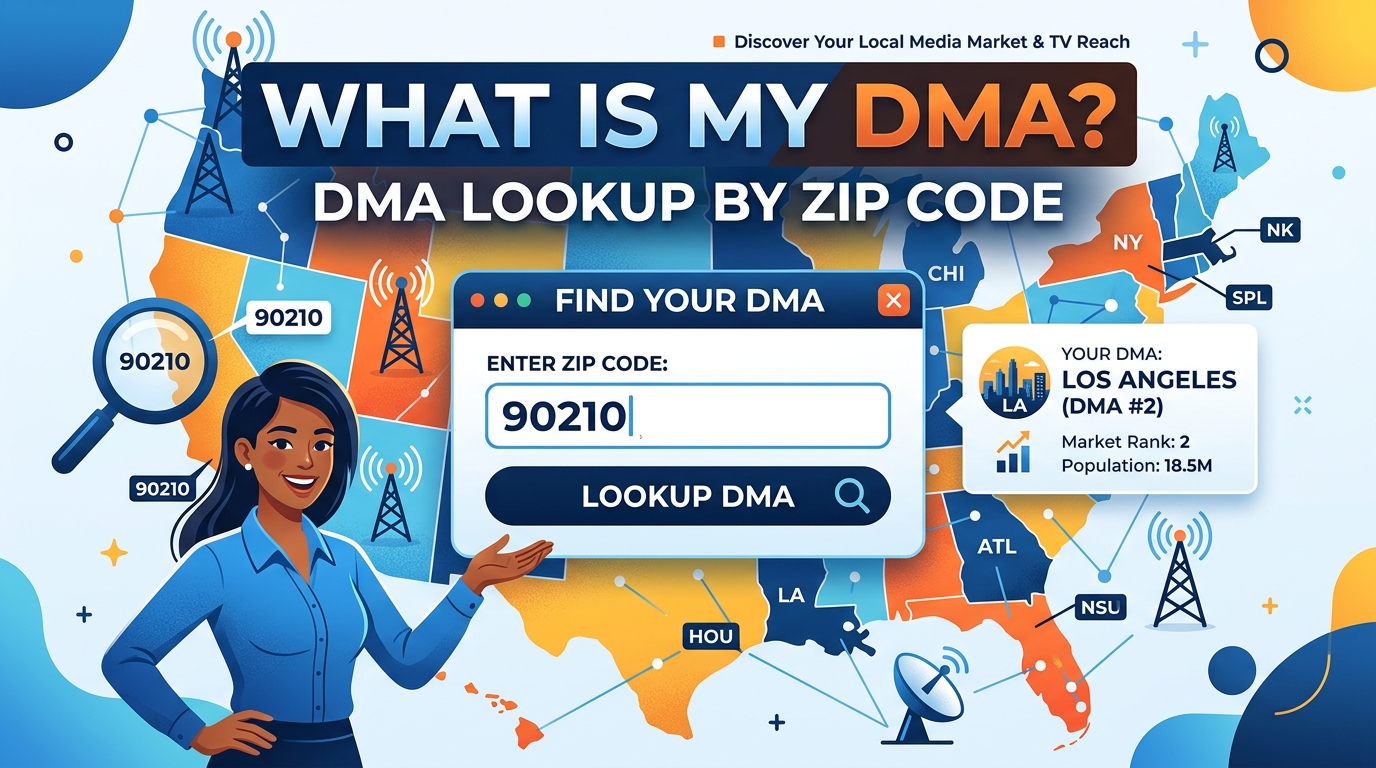
If you want to know “What DMA am I in?”, your ZIP Code is a practical starting point for finding the local television market associated with your location.
A Designated Market Area (DMA) is a U.S. television market defined by Nielsen. There are 210 DMA regions, covering the continental United States, Hawaii, and parts of Alaska. A DMA can include multiple counties and ZIP Codes, so your ZIP Code is not itself a DMA.
Quick answer
ZIP Code → Geographic area → DMA → Local TV market
For example, if you enter a U.S. ZIP Code into a current ZIP-to-DMA lookup, the result should identify the corresponding DMA market, such as New York, Los Angeles, Chicago, Houston, or another Nielsen television market.
If you first want to understand what a DMA is and see the U.S. DMA map and complete market list, see our Designated Market Area (DMA) guide.
How to Find Your DMA by ZIP Code
The basic process is simple:
- Find your 5-digit U.S. ZIP Code.
- Match the ZIP Code with the applicable DMA data.
- Identify the corresponding DMA market.
- Use the DMA market name when researching local television advertising, audience data, or media markets.
Nielsen’s official ZIP by DMA database contains ZIP Code listings organized by DMA region and is produced annually. Nielsen says the database contains 51,000+ ZIP Codes and is available as an Excel data file.
ZIP Code and DMA are not the same thing
| ZIP Code | DMA |
|---|---|
| Postal geography | Television-market geography |
| Used for addresses and mail | Used for local TV audience measurement |
| Identifies a postal area | Identifies a television market |
| Can be used to look up a DMA | Can contain many ZIP Codes |
So the correct relationship is:
ZIP Code → Location → DMA
not:
ZIP Code = DMA
What DMA Am I In?
Your DMA depends on the geographic area associated with your location.
A DMA is a defined television market rather than simply the nearest major city. Nielsen describes a DMA region as a group of counties and ZIP Codes forming an exclusive geographic area in which the home-market television stations have the dominant share of viewing.
This means you may live outside the city used in the DMA’s name and still belong to that television market.
For example, a DMA named after a major city can cover surrounding communities and counties rather than stopping at the city’s municipal boundary.
DMA Lookup by ZIP Code
When looking up a DMA, the ZIP Code is useful because it gives you a specific geographic starting point.
Use this format:
| Lookup information | Result |
|---|---|
| ZIP Code | Your 5-digit ZIP Code |
| Geographic area | County or associated location |
| DMA | Nielsen television market |
| Market name | Name of the local TV market |
| DMA ranking | Position among U.S. television markets |
The DMA ranking is separate from the ZIP Code lookup. A ZIP Code tells you where the location is, while the DMA identifies the television market serving that geographic area.
You can also browse the complete U.S. market list in our Designated Market Area guide.
Why ZIP Code DMA Lookup Is Useful
Knowing your DMA can be useful when you need to understand the television market associated with a particular location.
Common uses include:
- Local television advertising
- Media buying
- Audience research
- Local market analysis
- Geographic segmentation
- Advertising planning
- Television market comparisons
- Market research
- Local media sales
Nielsen specifically lists local advertising, direct marketing, media sales, research samples, data segmentation, and mapping locations by DMA among uses for DMA data.
DMA vs. ZIP Code
A ZIP Code and a DMA answer different questions.
ZIP Code:
“Where is this postal location?”
DMA:
“Which local television market does this location belong to?”
A single DMA can contain many ZIP Codes. Conversely, using a ZIP Code as a starting point does not mean that the ZIP Code itself is the television market.
This distinction is important when using geographic data for advertising or media research.
Does Every U.S. ZIP Code Have a DMA?
Nielsen’s ZIP by DMA database provides ZIP Code listings within U.S. counties organized by DMA region. The current Nielsen report contains more than 51,000 ZIP Codes and is produced annually.
Because the underlying DMA data is updated, a ZIP-to-DMA assignment should be checked against the applicable data year rather than relying on an old lookup table.
Can a ZIP Code Have More Than One DMA?
ZIP Codes and DMA boundaries are different geographic systems, so you should not assume that a ZIP Code boundary corresponds exactly to a DMA boundary.
For a location-specific result, use current ZIP-to-DMA data rather than trying to determine the DMA from the ZIP Code number itself.
The most reliable source for current ZIP-to-DMA assignments is Nielsen’s ZIP by DMA data. Nielsen states that the data is produced annually and that its DMA boundaries and data are proprietary.
Is There a Free Nielsen DMA Lookup?
Nielsen’s official ZIP by DMA database is a licensed data product rather than a free public lookup database.
Nielsen states that its ZIP by DMA report contains more than 51,000 ZIP Codes, is provided as an Excel file, and is licensed for 12 months from the date of purchase.
Therefore, websites offering a free DMA lookup may rely on other datasets or older geographic information. When accuracy matters, check the source and data year before using the result.
Why DMA Lookup Results Can Change
DMA assignments are not the same as permanent postal or political boundaries.
Nielsen maintains the DMA system and its geographic data. The current system contains 210 DMA regions, and Nielsen provides updated DMA-related data products, including ZIP by DMA reports and DMA boundary files.
This means an older ZIP-to-DMA list may not necessarily represent the current market assignment.
For this reason, check:
- Data year
- Data source
- ZIP Code
- DMA market name
- Applicable DMA boundaries
when using DMA information for business or research purposes.
What Is a Nielsen DMA?
A Nielsen DMA is a designated market area used by Nielsen to measure local television viewing.
Nielsen describes DMA regions as standardized geographic areas where local television viewing is measured. The 210 regions cover the continental United States, Hawaii, and parts of Alaska.
Nielsen also provides separate data products for:
- ZIP by DMA
- U.S. television household estimates
- DMA market and demographic rankings
- DMA shapefiles
- DMA maps
- TV station directories
DMA Lookup by City or County
A ZIP Code is not the only way to identify a DMA.
You may also start with a:
- City
- County
- ZIP Code
- Geographic coordinate
- Address
The important step is matching the location with the applicable DMA geographic definition.
Because DMA regions can cover multiple cities and counties, searching only for the nearest major city may not always give the correct DMA.
For a broader explanation of how DMA geography works, see our What Is a Designated Market Area? U.S. Map, List, Rankings & Lookup.
DMA Lookup Example
Suppose you want to identify the television market associated with a particular U.S. ZIP Code.
The process looks like this:
Step 1: Enter the ZIP Code
↓
Step 2: Identify the associated geographic area
↓
Step 3: Match the location with the current DMA data
↓
Step 4: Identify the DMA market
↓
Step 5: Check the DMA’s market information or ranking
The result might look like:
| Field | Example |
|---|---|
| ZIP Code | 10001 |
| DMA | New York |
| Market type | Local television market |
| DMA rank | Check current ranking |
| Data source | Current DMA dataset |
The example above illustrates the lookup process; the exact ZIP-to-DMA assignment should be verified using current source data.
DMA Ranking and Market Size
Once you know your DMA, you can also look up its position among U.S. television markets.
For example, the largest markets include major television markets such as:
- New York
- Los Angeles
- Chicago
- Dallas-Fort Worth
- Philadelphia
The complete 210-market DMA ranking is available in our main Designated Market Area guide.
Remember that a DMA ranking describes the relative position of the television market, not the population rank of the city itself.
Frequently Asked Questions
What is my DMA?
Your DMA is the Nielsen-defined television market associated with your geographic location. A ZIP Code can be used as a starting point for finding the applicable DMA.
How do I find my DMA?
Use your U.S. ZIP Code, city, or county and match the location with current DMA data.
What is a DMA lookup?
A DMA lookup identifies the Designated Market Area associated with a particular geographic location.
Can I find my DMA by ZIP Code?
Yes. Nielsen provides a ZIP by DMA database that lists more than 51,000 U.S. ZIP Codes by DMA region.
Is a DMA the same as a ZIP Code?
No. A ZIP Code is postal geography, while a DMA is television-market geography.
Is a DMA the same as a city?
No. A DMA can cover multiple cities, counties, suburbs, and communities.
How many DMAs are there in the United States?
There are 210 DMA regions in the Nielsen system.
Who owns DMA data?
Nielsen states that DMA boundaries and data are owned exclusively by Nielsen.
Is the Nielsen ZIP by DMA data free?
Nielsen’s official ZIP by DMA report is a licensed data product. The report contains more than 51,000 ZIP Codes and is delivered as an Excel file.
Can I use an old DMA lookup?
You can encounter older DMA lookup datasets online, but current assignments should be checked against the applicable data year because DMA data is updated.
Find Your DMA
If you are trying to answer “What DMA am I in?”, start with your U.S. ZIP Code and match it with current DMA data.
The key distinction is simple:
ZIP Code = postal location
DMA = local television market
Nielsen currently defines 210 DMA regions across the United States, and its official ZIP by DMA report contains 51,000+ ZIP Codes organized by DMA region.
For the complete U.S. DMA map, 210-market list, DMA rankings, DMA codes, and explanations of DMA vs. ZIP Code and metro areas, continue to our complete Designated Market Area guide