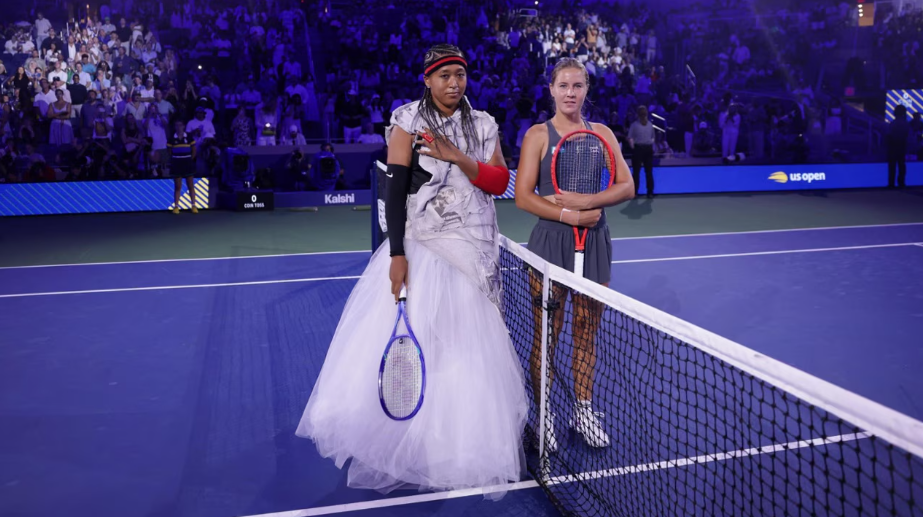
Naomi Osaka walked into Arthur Ashe Stadium looking less like a traditional tennis player and more like she was about to step onto an NBA court.
The crowd noticed immediately.
The cameras followed her.
And within minutes, the internet was talking about one question:
Was Naomi Osaka paying tribute to Allen Iverson?
The answer was yes.
But the outfit was only the beginning.
On Monday night, Osaka opened her 2026 US Open campaign with a dramatic straight-set victory over Anastasia Zakharova, winning 7-6(6), 7-6(3) in a match that lasted just over two hours. The victory sent the No. 13 seed into the second round — but it was her entrance that initially stole the spotlight.
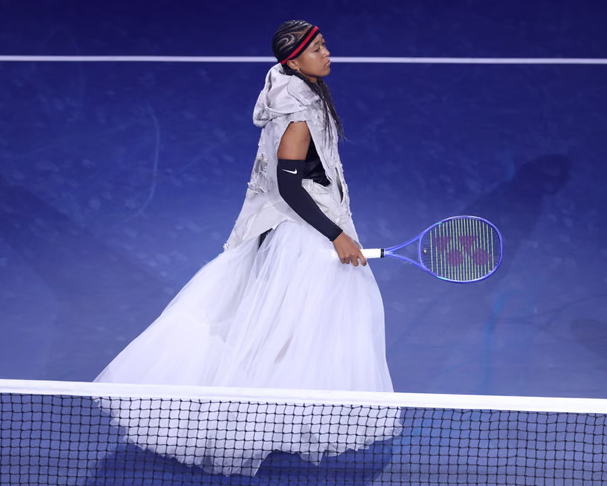
Osaka arrived wearing an oversized gray hooded robe covered with newspaper-style imagery, layered over a striking white tennis look.
Then she pulled back the hood.
Underneath was a hairstyle instantly recognizable to basketball fans: cornrows, paired with a headband and an arm sleeve.
It was a very deliberate reference to one of the NBA’s most influential style icons.
Allen Iverson.
And Osaka made it clear that this was no coincidence.
“It’s my, I guess, my tribute to Iverson. I really like him a lot.”
That one sentence explained the entire look.
But there was a much bigger story happening underneath the fashion moment.
Because Osaka wasn’t simply walking onto a tennis court dressed like a basketball star.
She was walking onto one of the biggest courts in tennis trying to prove that her best tennis may be returning at exactly the right time.
The Allen Iverson Tribute Was Impossible to Miss
Osaka has never been afraid to make fashion part of her tennis identity.
Over the years, her Grand Slam entrances have become events of their own.
But the 2026 US Open look was different.
It wasn’t merely glamorous.
It was cultural.
The outfit referenced basketball, hip-hop-era sports fashion and Iverson’s influence on how professional athletes express themselves away from traditional uniforms.
The Guardian reported that Osaka wore a long white skirt and a gray hooded robe featuring newspaper clippings about herself before revealing the cornrows underneath. She also wore an arm sleeve — another signature element associated with Iverson during his NBA career.
And there was a reason Osaka chose Iverson.
She had previously spoken about him as someone she admired not only as a basketball player, but also as a fashion trailblazer.
Iverson changed the conversation around how NBA players could dress.
He made cornrows, tattoos, oversized clothing, headbands and sleeves part of a visual identity that eventually became deeply connected to basketball culture.
For Osaka, that influence clearly resonated.
She explained that Iverson helped shift the way athletes thought about clothing and self-expression.
And there was another detail that made the moment even more interesting:
Osaka had never actually met Iverson.
At least, not before this tournament.
Then Allen Iverson Responded
If Osaka’s tribute had ended with her walking onto the court, it would already have been memorable.
But Iverson himself saw it.
And he responded.
Iverson posted a message on Instagram expressing his excitement and saying he was a big fan of Osaka and hoped to meet her.
That turned a fashion tribute into a cross-sport moment.
A tennis champion paying homage to an NBA legend.
An NBA legend responding to a tennis champion.
And suddenly, one of the biggest fashion stories from the first days of the US Open had become a conversation about the relationship between sports, culture and personal identity.
For Osaka, that connection makes sense.
She has consistently treated clothing as another form of storytelling.
Her Grand Slam outfits often communicate something about her identity, heritage, interests or the culture surrounding her.
The clothes are not simply decoration.
They are part of the entrance.
And for a player who has become one of tennis’ most recognizable global personalities, that entrance matters.
Osaka’s US Open Outfit Had a Second Layer
There was something else unusual about the look.
The outfit included newspaper-style references to Osaka herself.
That detail transformed the robe into something resembling a scrapbook of her own public life.
It was almost as if Osaka was wearing the headlines before creating another one.
And then she did exactly that.
She stepped onto Arthur Ashe Stadium and won.
Not easily.
Not comfortably.
But she got the job done.
Naomi Osaka Survives a Major First-Round Test
The official result tells a simple story:
Naomi Osaka defeated Anastasia Zakharova 7-6(6), 7-6(3).
The reality was much more complicated.
Osaka started strongly and established a 5-2 lead in the opening set.
Then everything became tense.
Zakharova fought back.
She broke Osaka late in the set and eventually forced the match into a tiebreak.
The Russian player even held two set points.
But Osaka managed to recover.
She took the first-set tiebreak 8-6.
And suddenly she was halfway to the second round.
The second set followed a similar pattern.
Osaka built momentum.
She created separation.
Then Zakharova refused to disappear.
The No. 101-ranked player repeatedly made Osaka work for every important point.
Eventually, Osaka closed out another tiebreak, winning it 7-3.
Two sets.
Two tiebreaks.
One extremely nervous night.
“It Took Everything”
After the match, Osaka did not pretend that the victory had been easy.
It wasn’t.
“It took everything,” she said.
That may be the most revealing description of the match.
Osaka entered the tournament after not playing since Toronto.
She acknowledged that she felt rusty.
She also admitted that first-round matches at the US Open make her nervous.
That’s understandable.
This is the tournament where Osaka became a global star.
She won her first US Open title in 2018, defeating Serena Williams in one of the most talked-about finals in modern tennis.
She won again in 2020.
And now, years later, she is trying to build another deep run in New York.
The pressure is different.
The player is different.
And Osaka herself is different.
A Different Naomi Osaka Is Emerging
The most interesting part of Osaka’s 2026 season may not be her ranking.
It may be her movement.
According to the official US Open report, Osaka has become noticeably more mobile since returning from a year-plus hiatus following the birth of her daughter.
That change was visible again against Zakharova.
Osaka has always possessed enormous power.
Her serve can be devastating.
Her forehand can overwhelm opponents.
Her groundstrokes can turn defense into offense in a matter of seconds.
But mobility has not always been the first thing people associated with her game.
Now it is becoming increasingly important.
The US Open described her movement as one of the revealing developments of her resurgence.
That matters because hard-court tennis at the highest level demands much more than hitting powerful shots.
Players need to recover quickly.
They need to defend.
They need to change direction.
They need to turn neutral rallies into attacking opportunities.
And they need to do it repeatedly for hours.
Osaka appears increasingly comfortable doing exactly that.
Her Serve Still Looks Like a Major Weapon
Even when her game became uneven against Zakharova, Osaka’s serve remained one of the biggest differences between the two players.
That is important.
When Osaka’s first serve is working, opponents can find themselves under immediate pressure.
A strong serve creates free points.
It creates weaker returns.
And it gives Osaka the opportunity to dictate the next shot.
Against Zakharova, her serve and heavy groundstrokes eventually proved decisive.
The official US Open report noted that Osaka finished with 20 winners compared with Zakharova’s 13, while also making fewer unforced errors, 30 to 34.
Those numbers tell an interesting story.
Osaka did not play a flawless match.
But when the important points arrived, she had more weapons.
Zakharova Refused to Make It Easy
It would be unfair to describe the match simply as Osaka surviving her own mistakes.
Zakharova played a major role in making the match so difficult.
The 24-year-old Russian entered the tournament ranked No. 101 and was making only her third US Open appearance.
She fought relentlessly.
She chased down balls.
She stayed aggressive.
And every time Osaka appeared ready to pull away, Zakharova found another way back.
That is what made the two tiebreaks so important.
Osaka was not allowed to cruise through the match.
She had to earn the victory.
And that may ultimately be valuable for her.
A comfortable first-round win would have been nice.
A difficult two-hour battle may have been better preparation for what comes next.
Osaka Admits She Was Nervous
Osaka’s post-match comments were surprisingly honest.
She said she had not played since Toronto and felt rusty.
She also acknowledged that she gets nervous in the first round of this tournament.
That vulnerability is worth remembering.
When fans see a former Grand Slam champion walk onto Arthur Ashe Stadium, it can be easy to assume she feels completely comfortable.
But Osaka knows what this tournament means.
This is the place where she became a two-time champion.
It is also the place where some of the most emotionally complicated moments of her career have happened.
Walking back onto that court is never going to feel ordinary.
The Fashion and Tennis Stories Are Actually Connected
At first glance, Osaka’s Iverson outfit and her tennis performance may seem like completely separate stories.
They aren’t.
Both are about identity.
The outfit said:
This is who I am.
The match said:
This is what I can still do.
Osaka has spent much of her career navigating the expectations placed on elite athletes.
She has also become increasingly comfortable choosing how she wants to present herself.
The Iverson tribute was therefore more than a clever costume.
It was another example of Osaka using a major sporting stage to express something about herself.
And that is precisely what made the look so memorable.
Why Allen Iverson Was the Perfect Inspiration
Iverson’s influence extends far beyond basketball.
He was one of the players who helped erase the boundary between sports and street fashion.
Before Iverson, professional athletes were often expected to maintain a certain polished image.
Iverson challenged that.
His style became part of his identity.
His cornrows became iconic.
His arm sleeve became iconic.
His attitude became iconic.
And his willingness to be himself became one of his defining characteristics.
Osaka clearly understands that connection.
She is also an athlete whose appearance, personality and fashion choices have become part of her public identity.
In that sense, the tribute feels almost inevitable.
It is one influential athlete recognizing another.
Osaka Had Another Reason to Celebrate
The fashion moment would have been enough to dominate social media.
But Osaka also walked away with something much more important:
A win.
The victory moved her into the second round.
And it continued what has become an increasingly promising 2026 season.
The official US Open report noted that Osaka had won five of her previous seven hard-court matches entering the tournament.
She reached the semifinals in Washington, D.C., and the quarterfinals in Toronto.
Before that, she reached her first Wimbledon quarterfinal and defeated then-No. 1 Aryna Sabalenka in the fourth round.
She also reached the quarterfinals at Roland Garros.
That is not the profile of a player simply trying to rediscover her old form.
It is the profile of a player who may be building toward something much bigger.
Osaka’s Grand Slam Numbers Tell an Interesting Story
Her 2026 Grand Slam results are particularly intriguing.
With the victory over Zakharova, Osaka’s Grand Slam record for the year moved to 10-2.
That is the first time she has reached double-digit Grand Slam wins in a season since 2009, according to the official US Open report.
There is also another milestone.
Osaka has now reached 14 career finals, including her first grass-court final this summer in Bad Homburg.
She is not simply making appearances.
She is getting deep into tournaments.
And that changes the conversation around her.
Instead of asking whether Naomi Osaka can return to the top, fans are beginning to ask a more exciting question:
How far can she go?
The Comeback Has Become Much More Interesting
Osaka’s comeback has never been simply about rankings.
It has been about finding a version of herself that can coexist with everything else in her life.
She is now a mother.
She is still an elite athlete.
She is still one of the most recognizable figures in tennis.
And she is trying to compete at the highest level again.
That requires more than physical preparation.
It requires rebuilding confidence.
It requires learning how the body responds.
It requires accepting that some days will be messy.
Monday night was one of those messy days.
But Osaka won anyway.
And sometimes that is the most encouraging sign.
The Next Challenge Is Katerina Siniakova
Osaka’s next opponent is Katerina Siniakova.
The official US Open report notes that Osaka holds a 2-1 career head-to-head record against Siniakova.
That makes the second round particularly interesting.
Siniakova is an experienced competitor who can make opponents uncomfortable with variety and consistency.
Osaka, meanwhile, will be looking to bring the power that carried her through the first round while reducing the stretches of inconsistency that allowed Zakharova back into the match.
The first round showed both sides of Osaka’s current game.
The explosive version.
And the vulnerable version.
The next match could tell us which one is becoming more dominant.
And Yes, Osaka Promised More Outfits
After surviving the match, Osaka delivered perhaps the most entertaining tease of the night.
She told the Arthur Ashe crowd:
“I want to show you guys some more outfits.”
That sentence may have been half joke, half promise.
But fans are already listening.
Because if the Iverson tribute was only the first major look of the tournament, what comes next?
Osaka’s Grand Slam fashion has become part of the event itself.
At Wimbledon earlier this year, she made headlines with an elaborate white ensemble inspired by Japanese ceremonial clothing, incorporating vintage kimono materials, cranes, cherry blossoms and a traditional obi-inspired design.
At the US Open, she has shifted from Japanese tradition to basketball culture.
That contrast says a lot about her range.
She can reference heritage.
She can reference sport.
She can reference pop culture.
And she can turn all of it into something uniquely her own.
The US Open Has Become Osaka’s Fashion Runway
There is something almost theatrical about the way Osaka approaches Grand Slam entrances.
The walk onto court is no longer simply a walk onto court.
It is an introduction.
A statement.
Sometimes even a performance.
For a few seconds, the audience is not thinking about rankings, break points or unforced errors.
They are thinking:
What is Naomi wearing?
And then the tennis begins.
That combination is part of what makes Osaka such a fascinating modern athlete.
She can dominate the conversation before hitting a single ball.
But she still has to back up the spectacle once the match starts.
Against Zakharova, she did.
The Most Important Part Was What Happened After the Outfit
It would have been easy for the Iverson tribute to become the entire story.
The photographs were spectacular.
The basketball connection was obvious.
Iverson himself responded.
Social media loved it.
But Osaka made sure the outfit was not the only headline.
She won.
And she won under pressure.
Two tiebreaks.
A comeback from Zakharova.
A match lasting more than two hours.
A difficult second set.
And ultimately, another US Open victory.
That is the part that matters most if Osaka is serious about making another deep run.
Fashion can create attention.
Winning creates momentum.
Could Naomi Osaka Make Another Deep US Open Run?
It is far too early to answer that question.
The women’s draw remains packed with elite players.
The tournament’s top seeds are still fighting for the title.
And every round will become more difficult.
But Osaka’s current form makes the possibility much more interesting than it seemed earlier in her comeback.
She has already demonstrated that she can beat elite opponents.
She has already reached major quarterfinals this season.
And now she has survived an uncomfortable opening match in New York.
The key will be consistency.
Can she maintain her movement?
Can she keep her serve under control?
Can she limit unforced errors?
Can she close matches without allowing opponents back into them?
Those questions will become increasingly important.
One Night, Two Naomi Osakas
Perhaps the most fascinating thing about Monday night was that fans saw two versions of Naomi Osaka.
The first appeared before the match.
Confident.
Creative.
Stylish.
Wearing an Allen Iverson-inspired look and turning the walk onto Arthur Ashe Stadium into a fashion moment.
The second appeared during the match.
Focused.
Frustrated.
Nervous.
Powerful.
And ultimately resilient.
The first Naomi attracted the cameras.
The second Naomi earned the victory.
And the combination may be exactly what makes this version of Osaka so compelling.
What This Win Means for Osaka
The first-round victory does not guarantee a deep run.
It does not mean Osaka has returned to her absolute peak.
And it certainly does not mean every remaining match will be easy.
But it does provide something extremely valuable:
Another win on a Grand Slam stage.
Another match under pressure.
Another opportunity to test her body.
Another chance to build confidence.
And another reason for fans to believe that her comeback is becoming more than a comeback story.
It is becoming a competitive story.
Final Takeaway: The Outfit Got Everyone Talking — The Tennis Made It Matter
Naomi Osaka arrived at the 2026 US Open with an Allen Iverson-inspired outfit, complete with cornrows, a headband, an arm sleeve and a basketball-themed aesthetic.
The fashion statement immediately grabbed attention.
Iverson himself responded.
Fans reacted.
The cameras loved it.
But then Osaka had to play tennis.
And that part was not nearly as easy.
She had to survive two tiebreaks against Anastasia Zakharova, recover after allowing a 5-2 first-set lead to disappear, and maintain her composure during a tense second set.
She did.
The final score:
Naomi Osaka 7-6(6), 7-6(3) Anastasia Zakharova.
Now she moves into Round 2 against Katerina Siniakova.
And suddenly, the biggest question surrounding Osaka is no longer simply what she will wear next.
It is what she can accomplish next.
Because the most exciting thing about Naomi Osaka’s 2026 US Open campaign may be that the fashion is only part of the comeback.
The real story is happening between the lines.
She has power.
She has experience.
She has already produced several impressive results this season.
And now she has another Grand Slam victory.
Perhaps the Iverson tribute was the perfect symbol for the night.
Iverson was never afraid to challenge expectations.
Neither is Osaka.
And if her first match is any indication, she may not be finished making noise in New York.
**The outfit got the attention.
The victory made the statement.
And there may be several more chapters left to come.**